
How AI is transforming multifamily operations in 2026 is no longer a hypothetical question. The transformation is already underway — and the gap between firms that have adopted AI and those still running on manual processes is widening faster than most operators expect.
For years, the multifamily industry was told that AI was coming. Vendors bolted chatbots onto legacy software and called it innovation. Consultants published reports predicting that "AI will reshape real estate by 2025." But on the ground, in the day-to-day work of regional managers, asset managers, and VPs of Operations, the reality was underwhelming. The dashboards were the same. The Monday morning reports still took three hours to build. The renewal risk still came as a surprise.
In 2026, something fundamentally different is happening. AI-native platforms — built from the ground up around machine learning and natural language processing, not added as an afterthought — have matured to the point where they are changing how multifamily portfolios actually run. Not in theory. In practice.
This guide is written for the operators in the middle of that shift: regional managers trying to understand what AI actually means for their weekly workflow, VPs of Operations evaluating whether to modernize their tech stack, asset managers building the business case for AI investment, and C-suite leaders deciding how fast to move. This is not a technology overview. It is an operational guide.
In this guide:
1. The Operational Tipping Point: Why 2026 Is Different | 2. How AI Is Transforming the Five Core Multifamily Operations | 3. What Agentic AI Actually Means for a Regional Manager | 4. Building the Modern Multifamily Tech Stack in 2026 | 5. Measuring AI ROI: What to Track and What to Expect
1. The Operational Tipping Point: Why 2026 Is Different
The multifamily industry has reached a genuine inflection point in 2026 — not because AI is new, but because the gap between AI-enabled operations and manual operations has finally become visible in the numbers.
Consider what a typical week looked like for an asset manager overseeing a 3,000-unit portfolio in 2022. Monday: download CSVs from the property management system. Tuesday: reconcile the data in Excel, cross-reference with the rent roll, try to understand why occupancy at one property dropped 1.8 points. Wednesday: build the weekly report for the ownership group. Thursday: send it out and immediately start receiving questions about numbers that were already four days old. Friday: repeat.
That workflow has not changed at most firms. But the competitive environment around it has changed dramatically.
The Three Forces Making the Old Way Unworkable
Rising portfolio complexity. Interest rate pressure over the past three years has compressed NOI margins at most portfolios. Operators who once had room to absorb inefficiencies — a missed renewal here, an unnoticed expense spike there — no longer do. Every decision point matters more.
Data volume has outpaced human capacity. A 2,000-unit portfolio generates thousands of data points per day: maintenance requests, leasing activity, utility consumption, vendor invoices, market rent movements, renewal notices, concession tracking. No team can monitor all of it manually. Things fall through the cracks not because people are careless, but because the data volume is genuinely unmanageable at human speed.
Competitor adoption is accelerating. Multifamily AI adoption in 2026 has accelerated sharply, with institutional operators moving from pilots to full deployment across their portfolios. Industry benchmarks show that AI adoption across institutional multifamily operations has grown significantly over the past two years, with a material share of larger portfolio operators now deploying AI tools for reporting, leasing, and risk management. Firms that haven't adopted AI aren't standing still — they're falling behind operators who are running faster with the same headcount.
The question in 2026 is no longer whether AI belongs in multifamily operations. It is how fast your firm can close the gap with the operators who are already running AI-enabled portfolios.
The shift happening now is not incremental. It is a genuine architectural change in how portfolios are managed — from reactive, human-driven data review to proactive, AI-driven intelligence. Understanding that shift is the starting point for every operational decision in 2026.
Resource: See the top challenges Muvan helps multifamily owners overcome without dedicated AI software
2. How AI Is Transforming the Five Core Multifamily Operations
AI is not transforming all of multifamily operations at once — it is transforming five specific areas first, and those five areas happen to account for the majority of where operator time, risk, and cost are concentrated.
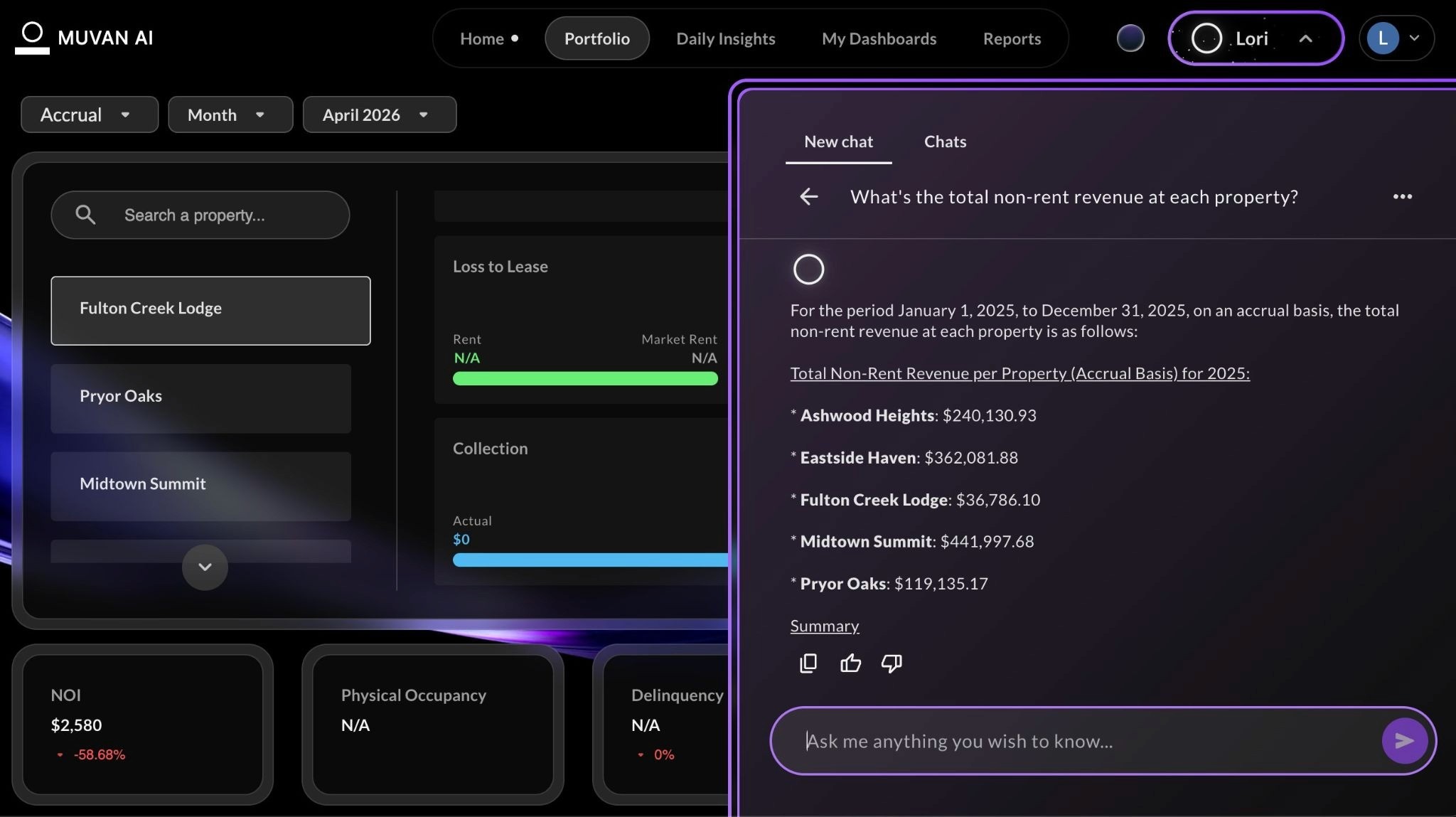
Operation 1: Portfolio Reporting
Reporting is where AI delivers its most immediate, measurable impact. The traditional Monday morning report — pulling data from the PMS, reconciling with Excel, formatting for the ownership group — is a process that takes between two and four hours per week at most firms managing 1,000+ units. Multiplied across a 52-week year, that is a material portion of a senior employee's time spent on data assembly rather than data analysis.
AI-native platforms automate the entire assembly process. The system connects directly to the PMS (whether that's Yardi, RealPage, or Entrata), pulls the latest data automatically, populates the firm's existing templates, and generates investor-ready summaries without human intervention. The asset manager's job shifts from building the report to reviewing it — a change that typically recovers 60 to 80 percent of the time previously spent on reporting.
The downstream effect is just as important as the time savings. When reporting is manual, it is weekly at best — because daily reporting would be unsustainable. When reporting is automated, it can be daily or even continuous. The ownership group gets fresher data. The regional manager catches problems earlier. The entire portfolio operates on a shorter feedback loop.
Operation 2: Renewal Risk Management
Renewal risk is one of the highest-leverage problems in multifamily operations, and it is one of the hardest to manage manually. A resident who is considering not renewing rarely announces it. The signal is in the data — a pattern of maintenance complaints, a rent-to-market gap, a lease that expires in a slow renewal window — but assembling those signals manually, across hundreds of units, is effectively impossible.
AI changes the renewal equation by doing what humans cannot: monitoring every unit simultaneously. An AI platform trained on multifamily data can identify residents with elevated move-out probability weeks before the lease expiration, giving the leasing team time to intervene. The intervention does not have to be aggressive — often, a proactive call or a targeted concession offer is enough to convert a likely non-renewal into a retained resident.
For a 500-unit property operating at 93 percent occupancy, preventing even four additional move-outs per quarter translates directly into NOI that would otherwise require new lease-ups to replace. The financial case for AI-driven renewal management does not require optimistic assumptions. It requires only that the system catches a handful of at-risk residents that a manual process would miss.
Operation 3: Expense Monitoring and Budget Variance
Expense leakage is the quiet NOI killer in multifamily. Vendor invoices that slightly exceed historical averages. A maintenance budget line that is trending toward exhaustion in month four of a twelve-month budget. Utility costs at one property that are 12 percent above the portfolio average for the same building type. None of these individually are catastrophic. Together, they represent significant value destruction across a portfolio.
Manual expense monitoring catches problems after the fact — typically when the monthly variance report shows a number that is already too late to fix. AI monitoring catches problems as they emerge, because the system is tracking every expense line in real time against both the budget and historical averages.
A regional manager overseeing eight properties does not have time to review every invoice. An AI platform can review all of them, flag the anomalies, and surface only the ones that warrant human attention. The manager's time is spent on decisions, not on hunting for variances in a spreadsheet.
Operation 4: Leasing Performance Tracking
Leasing performance data is some of the most actionable data in multifamily, and it is also some of the most underutilized. Most operators track occupancy and new lease volume. Fewer track tour-to-application conversion rates by unit type, lead source effectiveness by property, or the correlation between concession levels and lease velocity. Not because they don't want to — but because building those analyses manually is too time-intensive to be done consistently.
AI platforms make this analysis continuous and automatic. A VP of Operations overseeing a lease-up property can ask: "Which floor plans are converting at the lowest rate, and how does that compare to last month?" and get an immediate answer — not a data request that takes two hours to build. That kind of real-time leasing intelligence changes how quickly a team can adjust pricing strategy, concession levels, or marketing spend.
Operation 5: Market Positioning and Competitive Analysis
Understanding how a property is positioned against its competitive set used to require either expensive market data subscriptions or time-consuming manual research. AI platforms that integrate market data can automate this analysis, surfacing relevant competitive rent movements, new supply in key submarkets, or shifts in concession levels at nearby properties.
A VP of Operations can ask Lori: “Which of my Atlanta properties is priced above the competitive set this week?” and get an immediate answer with current comp data — without logging into a separate market research tool or waiting for a weekly report. According to PwC’s Emerging Trends in Real Estate® 2026, technology integration is emerging as a core differentiator for operators navigating compressed margins and increased competition in key submarkets. Market positioning is no longer a quarterly exercise — it is a continuous one.
Resource: See how AI platforms compare across these five operations: Multifamily AI Software Comparison 2026
3. What Agentic AI Actually Means for a Regional Manager
Agentic AI is the term the industry is using to describe AI that doesn't just answer questions — it monitors, detects, and acts on your behalf without being asked. Understanding the difference between a passive AI tool and an agentic AI platform is essential for anyone evaluating how AI will change their day-to-day work.
From Dashboards to Dialogue
The traditional property management software workflow is dashboard-centric. The regional manager logs in, navigates to the occupancy tab, checks the metric, navigates to the leasing tab, checks another metric, opens the expense module, tries to find the variance. This workflow assumes the manager knows what to look for and where to find it. It puts the cognitive burden entirely on the human.
Conversational AI inverts that model. Instead of navigating to the answer, the manager asks for it in plain English.
• "Which properties in my portfolio are seeing a decline in tour-to-lease conversion this month?"
• "Flag any properties where maintenance spend has exceeded budget by more than 10% this quarter."
• "Show me the net effective rent for all two-bedroom units and compare it to the market rate in each submarket."
• "Which residents at Oakwood Commons have a lease expiring in the next 90 days and show risk indicators for non-renewal?"
These are not hypothetical queries. They are the questions a regional manager asks every week. The difference is whether answering them takes two minutes or two hours.
The Agentic Layer: What Acts Without Being Asked
Conversational AI handles the questions you know to ask. Agentic AI handles the problems you don't know to look for yet. This is the capability that changes how operations actually feel on a day-to-day basis.
Proactive anomaly detection. The system monitors every property continuously. When unit turn times at one property start trending upward, the regional manager receives an alert — not because she ran a report, but because the AI detected the pattern and surfaced it automatically. She can investigate, address the staffing or vendor issue, and prevent occupancy impact before it shows up in the monthly numbers.
Continuous renewal risk scoring. Instead of a quarterly renewal review, the system maintains a live risk score for every lease in the portfolio, updating as new signals come in. A resident who filed three maintenance complaints, whose unit rent is now 8% above market, and whose lease expires in 60 days shows up at the top of the at-risk list — not because someone built a pivot table, but because the system built it automatically.
Budget burn monitoring. The system compares actual spend against budget on a rolling basis and alerts the relevant manager when a budget line is tracking toward exhaustion ahead of schedule. The manager reviews the alert, determines whether the variance is a one-time event or a structural issue, and takes action. The AI did the detection. The human does the judgment.
The shift from dashboards to agentic AI is not a software upgrade — it is an operational model change. The question moves from 'what happened?' to 'what do I need to know right now?'
For a regional manager overseeing eight properties, this shift is significant. The morning no longer starts with an hour of report review. It starts with a prioritized list of items that need attention — generated by the AI, triaged by importance, ready for human decision-making. The cognitive load decreases. The response time decreases. The quality of decisions improves because they are made with better information, faster.
Resource: Learn how Muvan’s AI copilot, Lori, delivers agentic intelligence across your multifamily portfolio
4. Building the Modern Multifamily Tech Stack in 2026
The most common misconception about AI adoption in multifamily is that it requires replacing your existing property management system. It does not. The modern multifamily tech stack in 2026 is not built on replacement — it is built on layering.
The AI Layer Concept
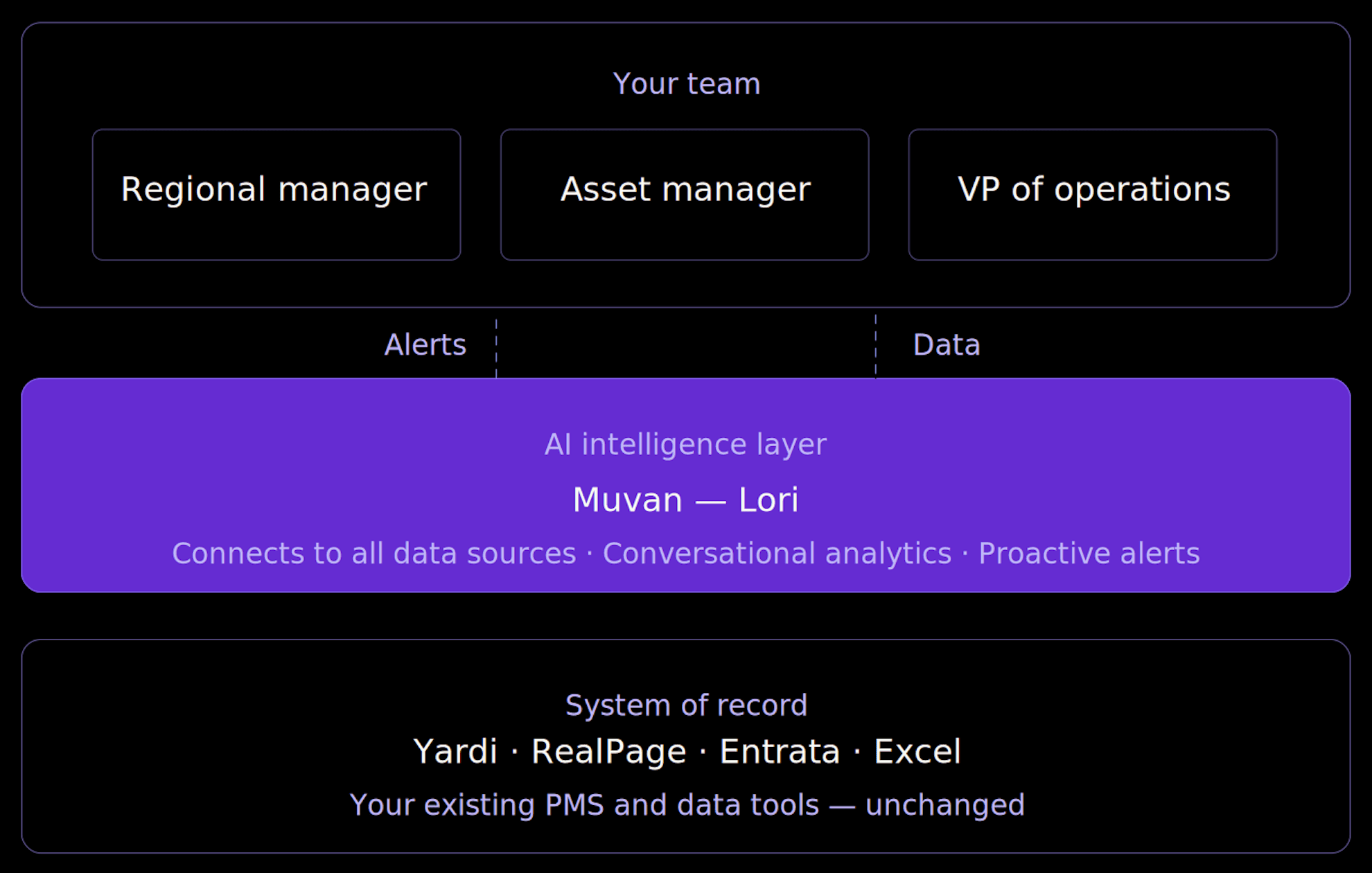
Think of your PMS — whether that is Yardi Voyager, RealPage, Entrata, or another platform — as the system of record. It stores leases, processes payments, manages maintenance workflows, and maintains the operational history of your portfolio. It does this reasonably well. What it does not do well is synthesize that data into actionable intelligence at the speed and scale a modern portfolio demands.
The AI layer sits above the PMS. It connects to your existing systems — PMS, Excel files, market data feeds, CRM — and translates the raw data into intelligence. It does not replace what the PMS does. It does what the PMS was never designed to do: understand patterns, detect anomalies, answer questions, and alert the team to what needs attention.
This architecture means that AI adoption is additive, not disruptive. A firm running Yardi does not need to migrate off Yardi to get the benefits of AI. They need to connect an AI platform to Yardi and let it do the work the PMS was not built for.
What a Modern Stack Looks Like
The modern multifamily tech stack in 2026 typically has three layers:
• System of record (PMS): Yardi, RealPage, Entrata, or similar. Handles leases, payments, maintenance, and compliance. This layer does not change.
• Data and workflow tools: Excel for custom models, CRM for resident communications, market data platforms for competitive intelligence. These also typically stay in place.
• AI intelligence layer: Connects to all of the above, synthesizes the data, and delivers conversational analytics, automated reporting, and proactive alerts. This is the new layer that is being added at firms that are adopting AI.
The integration between these layers is what determines whether AI adoption delivers value or creates complexity. AI platforms that require deep IT involvement, custom API work, or lengthy data migration projects tend to stall in implementation. Platforms that connect to existing data sources through standard integrations and deliver value within days are the ones that actually get used.
AI-Native vs. Legacy PMS: The 2026 Comparison
When evaluating how AI fits into your stack, the core distinction is between AI-native platforms — built from the ground up to deliver intelligence — and legacy PMS platforms that have added AI features as an afterthought. Here is how they compare across the dimensions that matter most to operators:
Capability | Legacy PMS + AI Add-on | AI-Native Platform (e.g. Muvan) |
Data interface | Static dashboards and exports | Conversational AI — ask questions in plain English |
Reporting | Manual templates, weekly exports | Fully automated, investor-ready in one click |
Risk alerts | Reactive — you notice the problem | Proactive — system flags issues before they escalate |
Integration complexity | Complex, often requires IT involvement | Connects to existing PMS and Excel within days |
Time to value | 3 to 6 months typical deployment | 7-day onboarding, live data from day one |
AI depth | Surface-level: email drafts, basic summaries | Portfolio-wide analytics, NOI modeling, anomaly detection |
Upgrade path | Dependent on vendor roadmap | AI layer improves continuously with your data |
The distinction that matters most is AI depth. Legacy PMS platforms that have added AI typically offer narrow, surface-level capabilities: a chatbot that drafts emails, a dashboard that summarizes occupancy. AI-native platforms offer portfolio-wide intelligence — the ability to ask any question about any property, get proactive alerts across all five operational areas covered in Chapter 2, and generate investor-ready reporting automatically. These are not incremental improvements. They are a different category of capability.
Resource: Full comparison of multifamily AI platforms: Multifamily AI Software Comparison 2026
5. Measuring AI ROI: What to Track and What to Expect
The business case for AI in multifamily is not hard to build — but it requires moving beyond vague claims about "efficiency" and grounding the analysis in specific, measurable operational outcomes. Here is how operators are measuring AI ROI in 2026, and what realistic expectations look like.
The Three ROI Buckets
Bucket 1: Time recovered from manual processes. This is the most immediate and easiest to quantify. Manual reporting for a 5,000-unit portfolio consumes an estimated 1,200+ hours per year in asset management time (based on Muvan operator benchmarks) — a figure that reflects weekly report building, quarterly investor package preparation, and ad-hoc analysis requests. AI automation recovers the majority of those hours. At a fully-loaded cost of $80 to $120 per hour for senior asset management staff, the time savings alone often covers the cost of an AI platform within the first year.
Bucket 2: Revenue protected through proactive risk management. This bucket is larger but requires more discipline to measure. The methodology: identify the number of at-risk renewals the AI flagged proactively that would likely have been missed by a manual process. Apply a conservative conversion rate (assume the intervention converted 25 to 30 percent of at-risk renewals that would otherwise have been lost). Calculate the avoided turnover cost per unit — typically $3,000 to $6,000 per turn when make-ready, vacancy loss, and leasing costs are included (industry average, varies by market and unit type).
Bucket 3: NOI improvement from expense control. AI-driven expense monitoring typically identifies 1.5 to 3 percent of total operating expenses in anomalies, budget overruns, and vendor billing irregularities that a manual review process would miss (based on Muvan operator benchmarks). On a $10M annual operating expense portfolio, that represents $150,000 to $300,000 in potential savings — not in every case, but consistently enough that it belongs in the business case.
The ROI of AI in multifamily comes from three places: time saved on manual reporting, revenue protected by catching renewals early, and NOI improved by catching expense anomalies before they compound.
Implementation Timeline: What to Expect
One of the primary objections to AI adoption is implementation complexity. The assumption, based on painful experience with traditional enterprise software, is that a new platform will take six months to deploy, require significant IT involvement, and disrupt operations during the transition period.
AI-native platforms that are built as intelligence layers — rather than replacements for existing systems — have fundamentally different implementation timelines. A typical onboarding process for a platform like Muvan looks like this:
1. Days 1-2: Connect existing data sources. The platform integrates with the PMS (Yardi, RealPage, Entrata) and any Excel-based reporting templates the firm currently uses. No data migration. No IT project.
2. Days 3-4: Configure reporting templates and dashboard preferences. The platform learns the firm's existing report formats and begins automating them.
3. Days 5-7: Define key metrics, set alert thresholds, and go live. The AI begins monitoring the portfolio and the team begins using conversational queries to access their data.
For firms that have attempted to implement traditional enterprise software, a 7-day timeline sounds implausible. But it is achievable because the AI layer approach does not require replacing anything — it requires connecting to what already exists.
How to Implement AI in Multifamily: A Practical Starting Point
For operators who have decided they need AI and are figuring out how to start, the practical sequence looks like this:
• Start with reporting. Automate the most time-consuming manual process first. The ROI is immediate and measurable, and it builds internal confidence in the technology.
• Add proactive monitoring in month two. Once the team is comfortable with the platform, activate renewal risk monitoring and expense anomaly detection. These require a brief calibration period as the AI learns your portfolio's normal patterns.
• Expand conversational analytics in month three. As the team builds fluency with AI-driven queries, the range of questions they ask expands naturally. The platform becomes the primary interface for operational intelligence rather than a supplementary tool.
The firms that fail at AI adoption typically do one of two things: they try to implement everything at once (creating change management overwhelm) or they treat AI as an IT project rather than an operations project. AI adoption succeeds when it is driven by the people who will use it day-to-day — the regional managers, the asset managers, the operations leads — not when it is imposed from the IT department.
Resource: See the multifamily AI platform that delivers 7-day onboarding: Best Multifamily AI Software 2026
The outlook for 2026 and beyond is clear. AI adoption in multifamily is not a future event — it is a present reality. The operators who are moving now are building operational capabilities that will be very difficult for slower-moving competitors to replicate once the gap widens further. The cost of waiting is not neutral. Every quarter of manual operations is a quarter of compounding disadvantage against AI-enabled competitors.
See AI in Action Across Your Portfolio
The operational shift described in this guide is not theoretical. Multifamily operators are running AI-enabled portfolios right now — with automated reporting, proactive renewal risk management, and conversational analytics that answer any question about any property in seconds.
Ready to see what that looks like for your portfolio? Request a demo at muvan.ai/start and experience Lori, Muvan's AI copilot, in action.
Related Articles:
• Multifamily AI Software Comparison 2026: Features, Platforms, and What Actually Matters
• Multifamily AI Software With the Best AI Features in 2026
• Explore the full Muvan AI Knowledge Base
Frequently Asked Questions
How is AI transforming multifamily property management in 2026?
AI is transforming multifamily property management in 2026 by automating reporting, enabling proactive risk detection, and replacing dashboard-centric workflows with conversational analytics. Operators are using AI to recover hundreds of hours per year from manual reporting, catch renewal risks before they become vacancies, and monitor expenses across large portfolios in real time — capabilities that were not achievable at scale with manual processes.
What does agentic AI mean for multifamily operators?
Agentic AI refers to an AI system that monitors your portfolio continuously and alerts you to issues without being asked — rather than simply answering questions when queried. For multifamily operators, agentic AI means the system flags anomalies, renewal risks, and budget overruns proactively, shifting the team's focus from data assembly to decision-making. The operational result is a shorter feedback loop and faster response to emerging problems.
How do regional managers use AI day-to-day?
Regional managers use AI through two primary workflows: conversational queries and proactive alerts. For queries, they ask the AI questions in plain English — "Which properties are seeing a decline in tour-to-lease conversion?" — and get immediate answers without navigating dashboards. For alerts, the system surfaces anomalies and risk signals automatically each morning, so the manager's day starts with a prioritized list of items that need attention rather than an hour of report review.
What is the ROI of AI in multifamily real estate?
The ROI of AI in multifamily real estate comes from three primary sources: time recovered from manual reporting processes (typically 60 to 80 percent of report-building time), revenue protected through proactive renewal risk management (preventing avoidable turn costs of $3,000 to $6,000 per unit), and NOI improvement from automated expense anomaly detection. For most portfolios managing 500+ units, the combined impact covers the cost of an AI platform within the first year.
How do you implement AI without replacing your existing PMS?
AI-native platforms are designed as intelligence layers that connect to your existing PMS — Yardi, RealPage, Entrata, or others — rather than replacing them. Implementation involves connecting the AI platform to your existing data sources, which typically takes days rather than months. The PMS continues to serve as the system of record for leases, payments, and maintenance, while the AI layer handles analytics, reporting automation, and proactive monitoring on top of that data.
What should be in a multifamily AI tech stack in 2026?
A modern multifamily AI tech stack in 2026 has three layers: a system-of-record PMS (Yardi, RealPage, Entrata) for operational data, existing workflow tools like Excel and CRM for specialized tasks, and an AI intelligence layer that connects to both and delivers conversational analytics, automated reporting, and proactive alerts. The key insight is that the AI layer is additive — it does not replace the PMS, it does what the PMS was never designed to do.