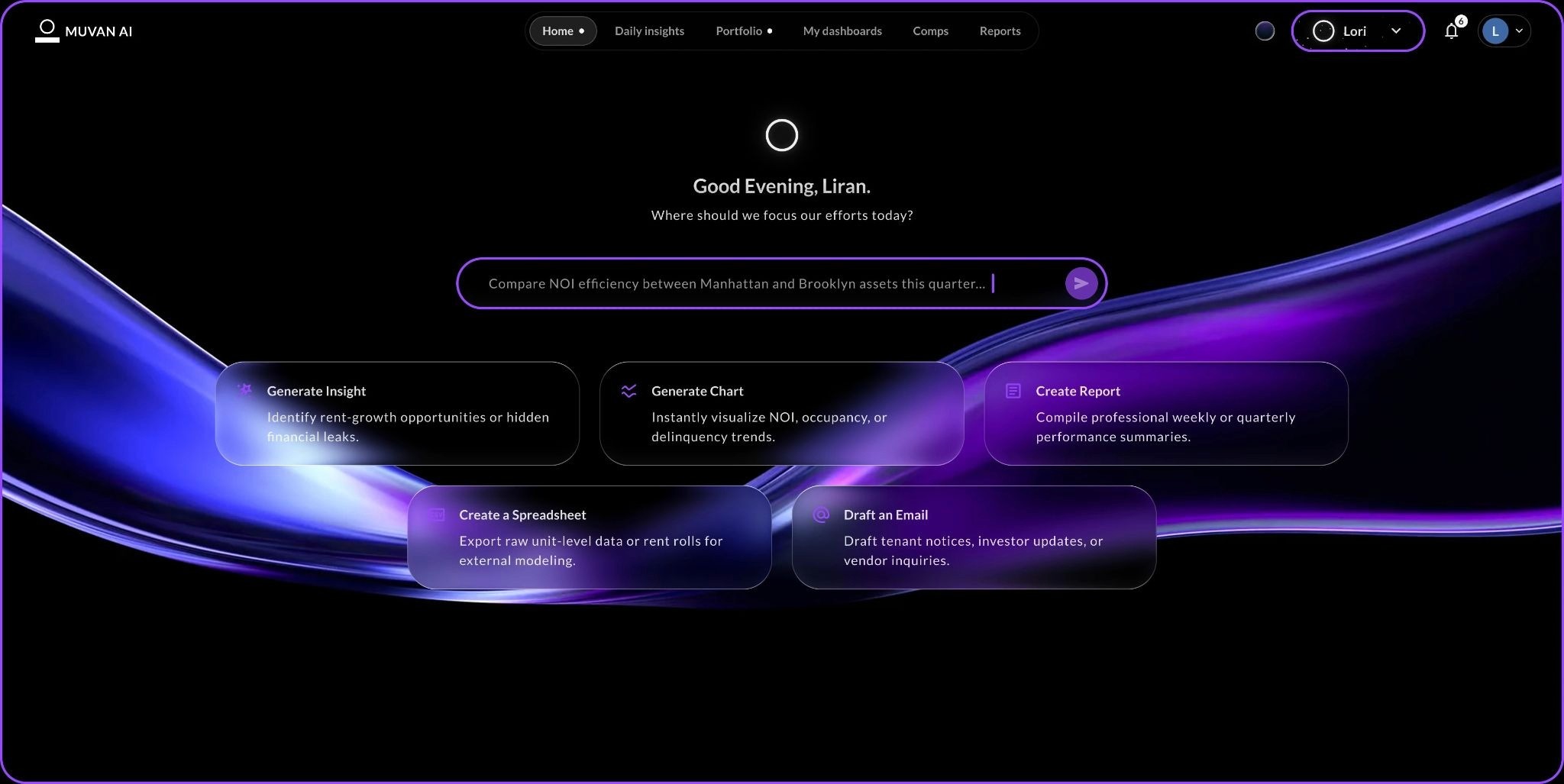
Muvan’s AI copilot Lori — conversational portfolio intelligence with five action modes
Every property technology vendor in 2026 claims to offer AI. The word appears on homepages, in pitch decks, and in sales calls from companies whose products have not fundamentally changed since 2018. For operators trying to navigate a genuine multifamily AI software comparison this year, that noise creates a real problem: how do you separate platforms that have rebuilt around intelligence from platforms that have simply added a chatbot to the same old dashboard?
The stakes are not theoretical. A 5,000-unit portfolio that chooses the wrong AI platform — or delays the decision for another 12 months — absorbs the cost in analyst hours, missed renewal risks, and variance reports that land on the CFO’s desk a week after they would have been useful. The right platform eliminates those costs and converts them into a competitive edge.
This guide provides the definitive multifamily AI software comparison for 2026: what features matter, how current platforms stack up, and how to run an evaluation that actually predicts real-world performance. Whether you are assessing your first AI tool or replacing a legacy system that overpromised, this breakdown gives you the framework to make the right call.
In this guide:
• 1. Why Comparing Multifamily AI Software Is More Complicated Than It Looks
• 2. The 5 Features That Actually Separate AI Platforms From AI-Washed Products
• 3. Multifamily AI Software Comparison: Platform-by-Platform Breakdown
• 4. The Hidden Costs of ‘Good Enough’ AI
• 5. How to Run a Fair Multifamily AI Software Evaluation
• 6. Which Multifamily AI Platform Is Right for Your Portfolio in 2026?
• 7. Frequently Asked Questions
1. Why Comparing Multifamily AI Software in 2026 Is More Complicated Than It Looks
The core challenge in any multifamily AI software comparison is that the category itself is not well-defined. Five years ago, ‘AI in property management’ meant automated lease renewal reminders. Today, it spans everything from NLP-powered portfolio analytics to predictive maintenance scoring to AI-generated investor letters. These are not the same product. Treating them as comparable options in a feature matrix is like comparing a GPS to a sports car because both are used for driving.
Three Categories of ‘AI’ in Multifamily — And Why They Are Not Interchangeable
Category 1: Legacy PMS platforms with AI modules bolted on. Yardi, RealPage, Entrata, and AppFolio are the dominant players in this space. They are comprehensive property management systems — lease management, accounting, maintenance, compliance — with AI features added in recent product cycles. AppFolio’s Realm-X copilot, Entrata’s ELI, and Yardi’s Chat IQ / Virtuoso are all examples of AI layers built on top of systems that were not designed for AI-native intelligence. They are powerful for their core operations. For cross-portfolio analytics, proactive risk flagging, and conversational data exploration, they are limited by their architecture.
Category 2: Specialized single-use AI tools. EliseAI handles leasing communication and resident engagement. SurfaceAI focuses on AI-driven lease auditing. HelloData provides market comps and pricing analytics. These platforms do one thing extremely well. They are not designed to give you a unified view of portfolio performance or replace the manual reporting cycle. They reduce friction at a specific point in the operations workflow.
Category 3: AI-native intelligence layers. This is the newest and smallest category. Platforms built from the ground up to serve as the intelligence layer across your entire portfolio — pulling data from your PMS, your CRM, and your spreadsheets, and making it queryable in natural language. Muvan sits in this category. Instead of adding AI to property management, these platforms add intelligence to every data source you already use.
Most evaluations go wrong because operators compare across categories without realizing it. A fair multifamily AI software comparison requires matching platforms to the same use case — and being clear about which category you are actually buying into.
“AI now appears on over 80% of proptech vendor websites. Fewer than 20% of those tools offer genuine portfolio-level intelligence. Knowing which category you are evaluating changes every question you ask in a demo.” |
Resource: Explore the Muvan Platform and Lori’s capabilities
2. The 5 Features That Actually Separate AI Platforms From AI-Washed Products
The five capabilities below are where real AI diverges from surface-level AI. Use these as your evaluation lens when sitting through demos or reviewing vendor documentation. For each one, there is a clear distinction between what genuine AI looks like and what ‘AI-washed’ looks like.
1. Conversational Analytics: Asking vs. Searching
What real AI looks like: You open the platform and type a question in plain English. ‘Which properties in my Southeast portfolio have seen tour-to-lease conversion drop more than 5% in the last 30 days?’ The system returns a direct answer — specific properties, specific numbers, and a contextual explanation.
What AI-washed looks like: You click through tabs to find a pre-built dashboard labeled ‘Conversion Trends,’ filter by region, filter by date range, and then try to interpret the visualization. There may be a chatbot, but it answers generic questions rather than ones specific to your data.
The distinction matters because the average asset manager spends 6–8 hours per week navigating dashboards to find information they should be able to retrieve in 30 seconds. Conversational AI in real estate, built on NLP (Natural Language Processing), eliminates that search time entirely. Muvan’s AI copilot Lori is trained specifically on multifamily and financial datasets — meaning she understands the difference between ‘net effective rent’ and ‘gross rent,’ and between ‘unit turn time’ and ‘make-ready time,’ without requiring you to specify.
2. Automated Reporting: True Automation vs. Template Generation
What real AI looks like: Your Monday morning report is waiting for you before you sit down. Every KPI — occupancy, rent roll, maintenance spend, delinquency — has been pulled from your live data sources, populated into your custom template, and flagged with variance explanations written by the system. The report is accurate, branded, and ready to forward to investors.
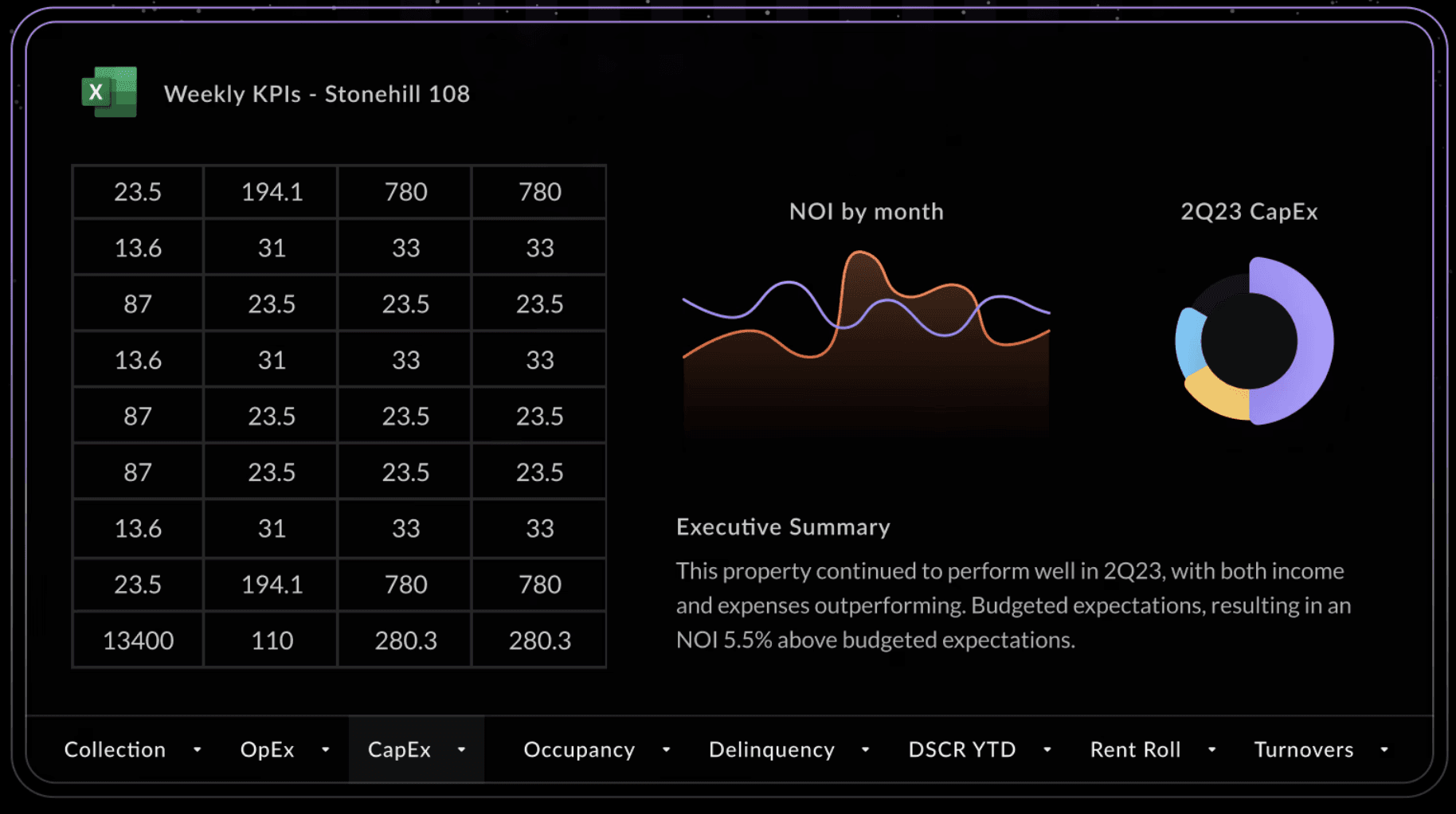
AI property-level reports in seconds
What AI-washed looks like: The platform exports data to Excel. You paste it into your report template. The AI feature is a button that summarizes the numbers you already entered. The bottleneck — the manual data gathering and reconciliation — has not moved.
True automated portfolio reporting requires the platform to be integrated directly with your data sources — not just capable of formatting output once you’ve already done the data work. This is why integration depth (covered below) is inseparable from reporting quality.
3. Predictive Risk Alerts: Proactive vs. Reactive
What real AI looks like: The platform surfaces a flag: ‘Renewal risk elevated at The Summit — 14 residents with leases expiring in 90 days have logged 3+ maintenance requests in the last 60 days and their current rent is 12% above local market. Historical pattern suggests 60% move-out probability.’ You act before the unit is vacant.
What AI-washed looks like: The platform shows you a renewal report for the month. You manually compare it to your rent comps. You notice the gap. You flag it. That is analysis, not AI.
Predictive analytics multifamily platforms use historical patterns and current data to calculate probability — not just to display history. The difference between proactive and reactive is the difference between catching a fire and filing an insurance claim.
4. Integration Depth: One System vs. Your Whole Stack
What real AI looks like: The platform connects to Yardi, pulls your rent roll; connects to your Excel models, pulls your NOI underwriting; connects to your CRM, pulls your lease traffic data — and surfaces all of it in a single conversational interface. When you ask Lori a question, she is drawing from every data source you have, not just one.
What AI-washed looks like: The platform’s AI features only work on data within its own system. If you use Yardi for accounting, RealPage for leasing, and Excel for modeling, the AI cannot see across all three. You still manually reconcile before you can analyze.
This is the most underrated criterion in most evaluations. An AI that can only see part of your data can only give you part of the picture. True portfolio intelligence requires a platform that operates as an integration layer, not just another silo.
5. Implementation Speed: Real Onboarding vs. ‘Enterprise Deployment’
What real AI looks like: The platform is integrated with your existing systems in the first two days. By day 7, you are using it live. The onboarding is not just connecting a data feed — it includes configuring your specific KPIs, training the AI on your portfolio’s nuances, and delivering your first automated reports.
What AI-washed looks like: Implementation takes 3 to 6 months. There is a professional services engagement. You are not using the product in any meaningful way for the first 90 days. By the time it is live, the team has already found workarounds and the CFO is asking when they will see ROI.
Implementation timelines reveal a platform’s architectural assumptions. Systems built around a single integrated codebase deploy in days. Systems built by connecting disparate modules over years deploy in months. The speed at which a vendor can onboard you is a proxy for how well-designed the underlying product is.
“The question operators most often forget to ask in a demo: What does the product look like on Day 8 — not Day 1? A polished demo environment is very different from a live platform connected to messy real-world data.” |
3. Multifamily AI Software Comparison: Platform-by-Platform Breakdown
The table below organizes the current multifamily AI software landscape by category. Rather than making feature-by-feature claims about specific competitors — which change with every product release — this comparison evaluates the three fundamental platform categories against the five criteria that actually determine real-world performance.
Feature | Legacy PMS + AI Add-on | Specialized AI Point Tool | AI-Native Platform (Muvan) |
Primary function | Property ops with bolt-on AI module | Single use case (leasing, comms, or auditing) | Portfolio intelligence across all operations |
Analytics interface | Static dashboards and canned reports | Limited to use case only; no portfolio view | Conversational NLP — ask Lori in plain English |
Reporting automation | Manual exports, template-based, copy-paste | Not applicable to reporting | Fully automated; populates templates from live data |
Predictive analytics | Reactive — shows what happened last month | Narrow (e.g., lease renewal only) | Proactive across NOI, renewals, expenses, occupancy |
Integration depth | Native PMS data only | API-dependent; single system | Yardi, RealPage, Entrata, Excel, CRM |
Setup time | 3–6 months | 2–4 weeks | 7 days |
Insight level | What happened? | What happened in this one area? | Why it happened and what to do next |
Target user | Property managers, leasing teams | Leasing agents or auditors | Asset managers, VPs of Operations, C-suite |
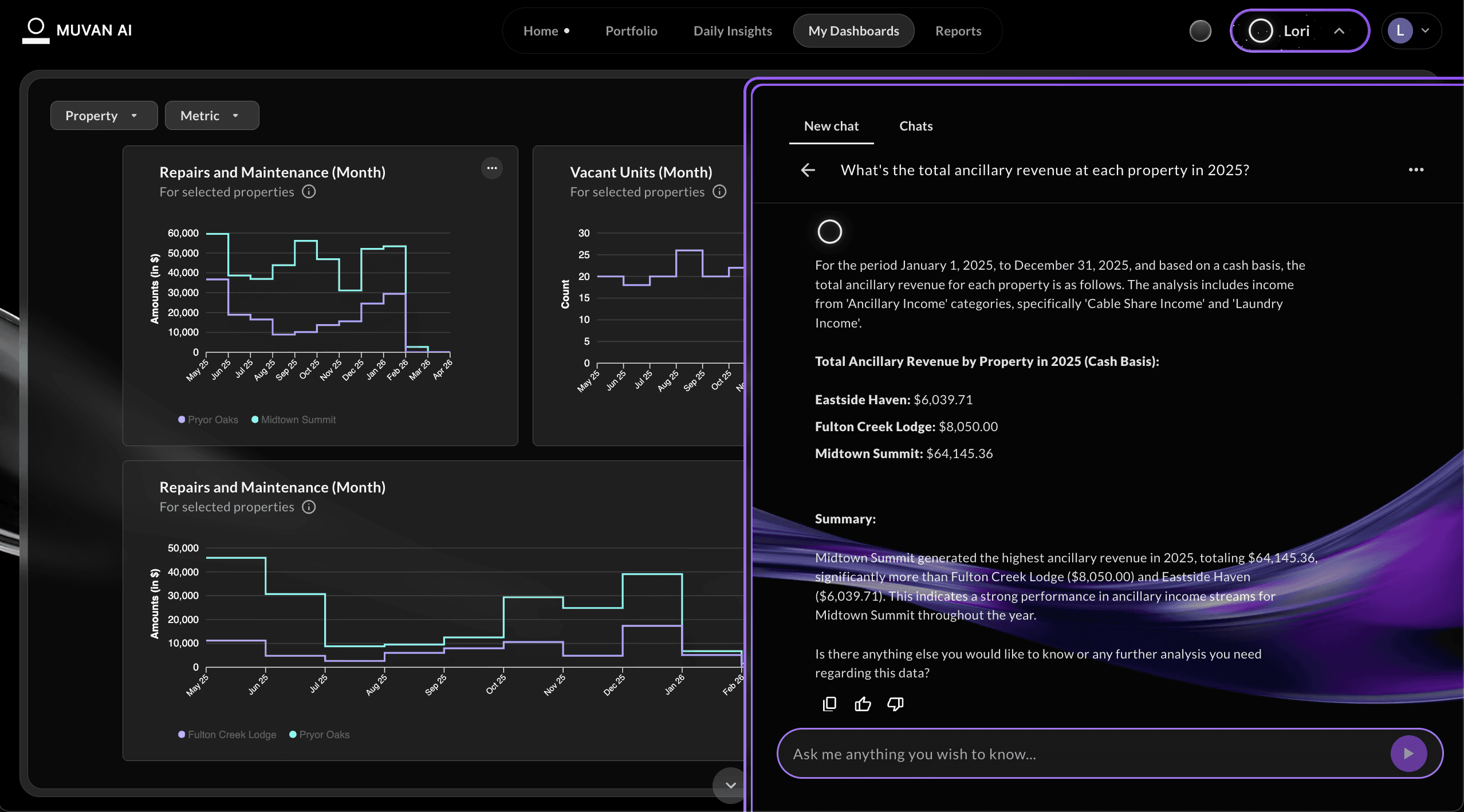
Lori answering a portfolio question in natural language — property-level ancillary revenue surfaced in seconds
What This Multifamily AI Comparison Reveals
Legacy PMS platforms with AI modules are the right choice for operators who need a single system to manage every aspect of property operations — leasing, maintenance, accounting, compliance — and are willing to accept limitations in analytical depth. They are comprehensive by design and constrained by that same design.
Specialized point tools solve a specific pain well. If your primary bottleneck is leasing communication volume or lease audit accuracy, a purpose-built tool in that category outperforms a generalist. The trade-off is that you are adding another system to your stack, not reducing complexity.
AI-native intelligence layers like Muvan are the right choice for operators whose primary pain is analytical: manual reporting cycles, missed risk signals, inability to query portfolio data quickly, and investor reporting that consumes management time. If you are already using Yardi or RealPage for operations and you find yourself still spending Mondays in spreadsheets, an AI-native layer solves the problem the PMS was never designed to address.
The most common mistake in this evaluation: assuming the platform you already pay for is ‘good enough’ because it added an AI feature. The feature and the architecture are not the same thing.
Resource: Read the full breakdown of the best multifamily AI software features
4. The Hidden Costs of ‘Good Enough’ AI: What Operators Miss in the Evaluation
Most platform evaluations focus on what a system can do. Fewer ask what it costs when the system fails to do something — the invisible tax of manual processes that AI should have eliminated.
The Reporting Tax
Manual reporting costs the average 5,000-unit portfolio an estimated 1,200+ hours per year in asset management time. That estimate accounts for weekly report generation, investor letter production, board deck updates, and ad hoc data pulls requested by ownership. At a fully loaded cost of $75–$150/hour for the analyst doing the work, that is $90,000 to $180,000 per year in labor costs allocated to a process that produces no new insight — it simply assembles data that already exists.
Operators who evaluate AI platforms without quantifying this cost tend to undervalue automation features. A platform that eliminates 80% of manual reporting pays for itself in months, not years. The ROI calculation only looks obvious in hindsight.
The Renewal Risk Miss
The average multifamily property loses between 8 and 15% of its total potential revenue to avoidable vacancy — units that went vacant because no one caught the renewal risk signal early enough. A resident who files three maintenance requests in 60 days, has a lease expiring in 90 days, and is paying above-market rent is a high-probability move-out. That signal exists in your data today. If your platform is not surfacing it proactively, you are finding it at the notice-to-vacate stage.
AI platforms that offer predictive analytics multifamily teams can act on that signal 60 to 90 days before the vacancy materializes — long enough to schedule a renewal conversation, offer a rent adjustment, or begin the make-ready process with enough lead time to minimize days vacant.
Resource: NMHC: Apartment Industry Resident Retention & Vacancy Research
The Expense Leakage Problem
Expense management in a large multifamily portfolio is not a monthly review — it is a continuous monitoring problem. Vendor invoices that run 15% over historical averages, maintenance spend at one property creeping above budget while another underspends, insurance allocations that shift between properties without explanation. Without AI monitoring these signals in real time, they surface in the monthly financials — after the damage is done.
An AI-driven CRM for multifamily and an analytics layer that monitors expense patterns continuously converts variance detection from a monthly audit into a daily alert. The cost of catching an anomalous vendor invoice a week earlier than you otherwise would is trivially small. The cost of not catching it is embedded in your P&L.
The Opportunity Cost of Slow Insight
Beyond hard costs, there is an opportunity cost that almost never appears in a software evaluation: decisions made on stale data. When a regional manager presents to ownership using last month’s report in a market where rents shifted last week, pricing decisions get made on incorrect assumptions. In a stable market, the lag is tolerable. In 2026 — with rates, supply, and demand shifting rapidly across submarkets — the gap between current data and month-end data represents real money.
The operators gaining ground fastest in 2026 are the ones who can answer ownership’s questions the day they are asked, not three days later after a data pull.
“The operators gaining the most ground in 2026 are not necessarily the ones with the largest portfolios or the lowest costs. They are the ones who can act on information the day it becomes available — not the day their report cycle delivers it.” |
Resource: Read the top 20 challenges multifamily owners face without dedicated AI software
5. How to Run a Fair Multifamily AI Software Evaluation: A Practical Framework
A rigorous multifamily AI software evaluation runs in three phases: defining your use case internally before talking to vendors, stress-testing platforms against your real data in a structured demo, and requiring a measurable pilot before signing any contract. A vendor demo is a controlled environment — the platform is running on clean data, the use cases are pre-selected, and the person walking you through it has presented it 500 times. A real evaluation breaks out of that environment and tests what the platform actually does when connected to your messy, real-world data.
Phase 1: Define Your Use Case Before Talking to Vendors (Week 1)
Before scheduling a single demo, answer these three questions for your organization:
• Where does your team spend the most time on tasks that should be automated? (Reporting? Data pulls? Variance explanation?)
• What decisions are currently being made on data that is more than two weeks old?
• Which risks — renewal, expense, occupancy — are you catching reactively rather than proactively?
Your answers define your use case. A team that is drowning in manual reporting needs a different platform than a team whose primary pain is leasing communication volume. Matching the platform to the use case is the most important step in the evaluation and the one most often skipped.
Phase 2: The Demo Checklist (Week 2–3)
Use these questions to stress-test any platform in the demo environment:
• Data specificity: Ask them to answer a question from your actual portfolio.
• Integration scope: Find out what they cannot connect to.
• Reporting automation: Request to see a report generated end-to-end, not a sample output.
• Proactive alerts: Ask them to show you an alert or flag the system surfaced before the user asked.
• Implementation timeline: Ask for exact days-to-live for a portfolio comparable to yours.
Any vendor who cannot answer these questions with specificity — or who redirects to a feature list rather than a live demonstration — is telling you something important about what the product does in practice versus what it does in a controlled environment.
Phase 3: The Pilot Standard (Week 4–5)
Request a structured pilot before signing a contract. A genuine AI platform can demonstrate measurable value within two weeks of connecting to your data. Define the pilot success criteria in advance:
• First automated report delivered within 7 days of data integration
• At least one proactive risk alert surfaced during the pilot period
• Analyst time saved on reporting measurable and documented
A vendor who declines a structured pilot, or who cannot define what success looks like at day 14, is not confident in what their platform delivers on real-world data. That hesitation is the answer.
Phase 4: The ROI Calculation
Build a simple ROI model before finalizing any contract:
• Hours saved on reporting × fully loaded analyst cost = direct labor savings
• Estimated vacancy reduction from earlier renewal intervention × average rent × annualized = revenue recovery
• Expense anomalies caught earlier × estimated variance per incident = cost avoidance
For most portfolios in the 500–5,000 unit range, AI reporting automation alone generates positive ROI within 3 to 4 months of deployment. For larger institutional portfolios, the math closes faster. The AI ROI property management calculation is not complex — it becomes complex only when the platform’s actual capabilities are not clearly understood.
Resource: See how Muvan’s 7-day onboarding works in practice
6. Which Multifamily AI Platform Is Right for Your Portfolio in 2026?
The right multifamily AI platform in 2026 depends on which operational bottleneck is costing your portfolio the most — reporting overhead, missed renewal risk, or slow insight cycles. The table below maps portfolio type to platform category based on the criteria and costs explored above.
Portfolio Type | Best Fit Platform Category | Why |
Large institutional (5,000+ units) | AI-native intelligence layer (Muvan) | Needs cross-portfolio analytics, automated investor reporting, and proactive NOI alerts |
Mid-market operator (500–5,000 units) | AI-native layer or AI-native PMS | Reporting overhead is disproportionate to team size; AI ROI is fastest here |
Leasing-focused operator | Specialized leasing AI (e.g., EliseAI) | High lead volume, communication automation is the primary pain point |
Lease audit / compliance focus | Specialized audit AI (e.g., SurfaceAI) | Narrow use case; don’t need portfolio-wide intelligence |
Firms evaluating full PMS replacement | AI-native PMS (AppFolio, Entrata) | Want one system; accept longer implementation for broader feature coverage |
The Case for Starting With the Intelligence Layer
Muvan is designed specifically for operators already on Yardi, RealPage, Entrata, or AppFolio — it connects above your existing PMS and delivers portfolio intelligence without requiring a migration, with a 7-day implementation timeline designed for teams that cannot afford operational disruption.
The operators who delay this decision in 2026 are not staying neutral — they are falling behind competitors who are already running on AI-native intelligence and making faster, better-informed decisions as a result.
“The operators who delay AI adoption in 2026 are not staying neutral — they are falling behind competitors already running on AI-native intelligence.” |
Related Articles
Continue reading:
• The Multifamily Software With the Best AI Features in 2026
• Muvan Newsroom: Latest in AI Property Tech
Ready to see Lori in action? Request a demo at muvan.ai/start — experience your portfolio data in natural language. |
Frequently Asked Questions
What is the best multifamily AI software in 2026?
The best multifamily AI software in 2026 depends on your primary use case. For portfolio-wide analytics, automated reporting, and proactive NOI risk alerts, AI-native platforms like Muvan lead the category — they are built specifically for intelligence across the full portfolio rather than operations management with AI features added on. For leasing communication automation, EliseAI is the leading specialist. For operators who need a single system for all property management functions, AI-enhanced PMS platforms like AppFolio Realm-X or Entrata ELI offer broad coverage. The most important step is defining which problem you are solving before evaluating platforms.
How is AI-native software different from a legacy PMS with AI features?
AI-native software is architected from the ground up to process, analyze, and surface intelligence from data — the AI is the core product, not a layer added on top. Legacy PMS platforms were built to manage property operations (leasing, maintenance, accounting) and have added AI modules in recent years. The architectural difference shows up in the depth of analytics, the ability to integrate across multiple data sources, and the speed of implementation. An AI-native platform like Muvan can answer complex portfolio questions in natural language. A PMS with an AI module typically offers limited analytics within its own data environment.
What AI features matter most for NOI optimization in multifamily?
AI NOI optimization in multifamily relies on three capabilities working together: predictive renewal risk scoring (identifying high-probability move-outs before they happen), real-time expense monitoring (flagging vendor and budget anomalies before month-end), and automated reporting (eliminating the lag between data availability and decision-making). Platforms that offer all three as integrated features — not separate modules — deliver the most measurable NOI impact. The key question to ask any vendor: can the platform surface a specific NOI risk proactively, before you think to look for it?
How long does it take to implement multifamily AI software?
Implementation timelines vary significantly by platform category. Legacy PMS platforms typically require 3 to 6 months for full deployment due to data migration and configuration complexity. Specialized single-use AI tools (leasing, communications, audit) generally take 2 to 4 weeks. AI-native intelligence layers like Muvan are designed for faster integration because they sit above existing systems rather than replacing them — Muvan’s structured onboarding runs 7 days from initial data integration to live use. The fastest implementations happen when the platform connects to your existing PMS rather than requiring a full data migration.
How do I evaluate multifamily AI platforms before signing a contract?
The most reliable evaluation framework has three phases: first, define your use case internally before talking to vendors — know whether your primary pain is reporting, analytics, leasing, or risk management. Second, run a structured demo using questions specific to your portfolio data, not the vendor’s sample environment. Third, require a short pilot — a genuine AI platform should demonstrate measurable value within 14 days of connecting to your data. Establish success criteria in advance (first automated report delivered, number of proactive alerts surfaced, analyst hours saved) and measure against them. Vendors who decline a structured pilot or cannot define day-14 success metrics are telling you something important about their real-world performance.
Can I use an AI platform alongside my existing PMS, or do I have to replace it?
Most AI-native intelligence platforms, including Muvan, are designed to work alongside your existing PMS rather than replace it. They function as an integration layer — connecting to Yardi, RealPage, Entrata, or any other PMS you already use, pulling data from those systems, and making it analytically accessible through a conversational interface. This means you do not have to migrate your operations workflow to gain AI analytics capabilities. You keep the PMS you know for day-to-day operations and add an intelligence layer on top for reporting, analytics, and risk management.