MUVAN.AI · AI KNOWLEDGE BASE
4 Ways AI Tools Advance Multifamily in 2026: How Muvan Turns Data Into Decisions
Written by AI
The multifamily industry talks about AI constantly. Conference panels, vendor demos, LinkedIn thought leadership — everyone claims their software “uses AI.” But strip away the marketing language and ask a simple question: what do your AI tools actually do for your multifamily NOI? For most platforms, the honest answer is “not much.” A chatbot here, a templated email there — surface-level automation dressed in enterprise packaging. The real question in 2026 is not whether AI tools advance multifamily operations, but which tools deliver measurable financial outcomes and which ones are just noise.
The data tells a stark story. According to the 2025 State of AI in Multifamily report (a survey of 280 multifamily executives), 77% of operators using AI report moderate to significant reductions in operating expenses, and 85% have seen measurable improvements in lead-to-lease conversion rates. Yet the National Apartment Association’s Industry Pulse report on AI found that 54% of nearly 1,000 property management professionals surveyed still have no immediate plans for full AI adoption — and among those that have adopted, the weighted average of AI usage across operational functions remains below average on a 5-point scale.
That means most of the industry is either sitting on the sideline or using AI for the wrong things. The operators pulling ahead are the ones deploying AI tools that actually advance multifamily performance — tools built specifically for asset intelligence that go beyond AI chatbots and automated emails to surface revenue opportunities, analyze AI lead generation across the multifamily leasing pipeline, optimize ancillary income, and prioritize capital expenditures based on actual AI ROI data.
This article breaks down 4 concrete ways AI tools are advancing multifamily operations in 2026, with specific examples of how Muvan’s AI copilot, Lori — a natural language processing (NLP) model trained on multifamily and financial datasets — delivers each one. Whether you manage 500 units or 50,000, these are the capabilities that separate AI-native platforms from legacy software with an AI label.
[CALLOUT: 77% of operators using AI report moderate to significant reductions in operating expenses (2025 industry survey) — yet 54% of the industry still has no plans for full adoption (NAA). The gap is your competitive advantage.]
In this guide: 1. Revenue Optimization | 2. Leasing Funnel Analytics | 3. Ancillary Income Intelligence | 4. CapEx vs. ROI Prioritization | Comparison Table | FAQ
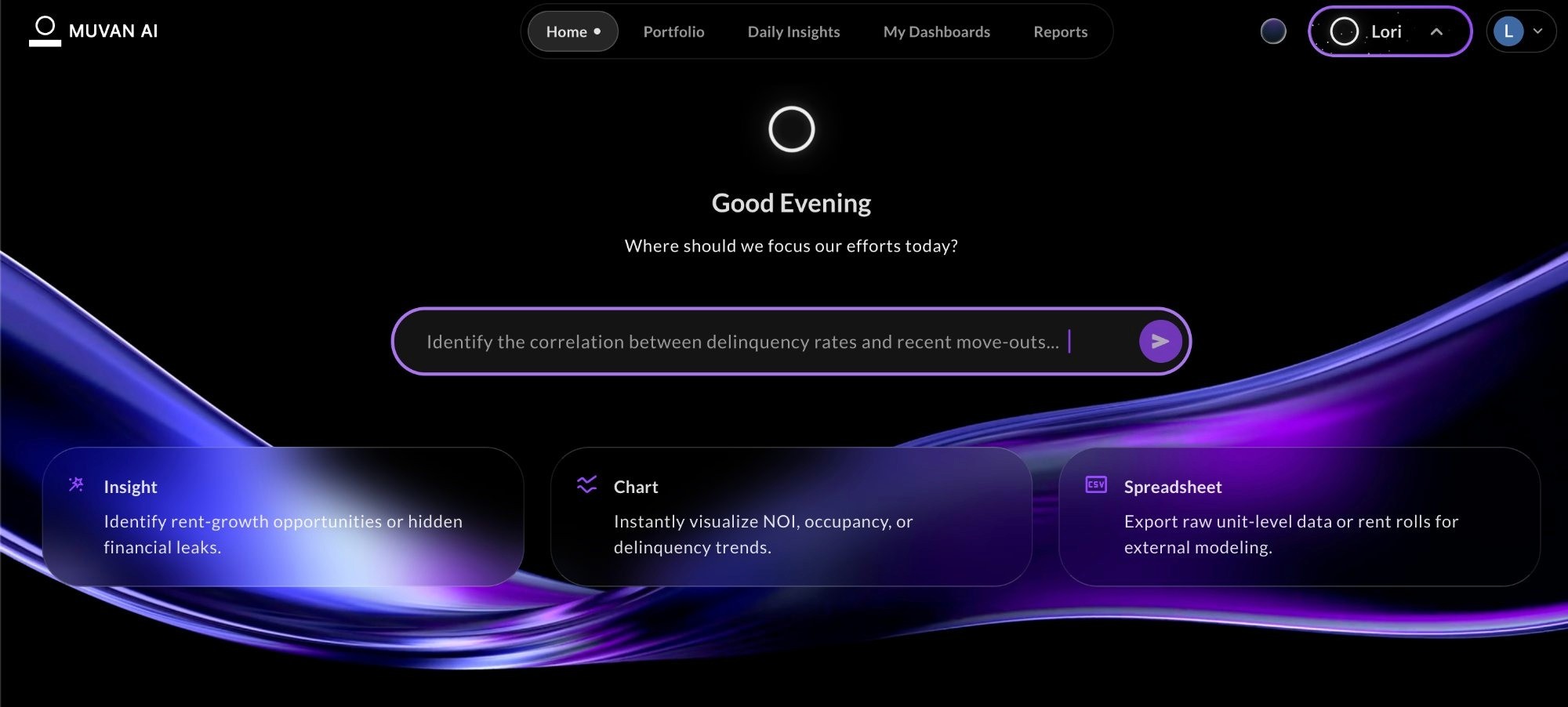
Muvan’s AI copilot Lori — conversational AI for multifamily portfolio intelligence
AI tools advance multifamily by automating revenue analysis, optimizing leasing funnels, benchmarking ancillary income, and prioritizing CapEx by ROI — replacing manual spreadsheets with real-time, portfolio-wide intelligence.
1. How Do AI Tools Find Multifamily Revenue You’re Leaving on the Table?
AI tools find multifamily revenue you’re leaving on the table by continuously monitoring loss-to-lease gaps, concession overages, and renewal pricing misalignment across your entire portfolio — replacing the quarterly spreadsheet audit with real-time, predictive analytics that surface opportunities the moment they appear.
Revenue leakage is the silent killer of multifamily NOI. It does not announce itself in a fire alarm or a burst pipe — it hides in the gap between what you charge and what the market supports, in concession packages that overshoot their purpose, in renewal pricing that fails to keep pace with submarket movement. For the average portfolio, these micro-losses compound across hundreds or thousands of units into six- and seven-figure annual shortfalls that never appear as a single line item on any report.
Traditionally, identifying revenue optimization opportunities required an asset manager to pull rent rolls from the PMS, export them to Excel, cross-reference submarket comps from a third-party data provider, and manually scan for units priced below market. That process takes days. By the time the analysis is complete, the data is stale and the recommendations are already lagging behind real-time market shifts.
The AI-Native Approach: Continuous Revenue Intelligence
AI tools built for multifamily revenue optimization work differently. Instead of static, periodic analysis, they monitor your portfolio continuously and surface specific opportunities the moment they appear. This is not a dashboard with a hundred filters — it is proactive intelligence that tells you exactly where your money is going and where you are leaving it behind.
Here is what that looks like in practice with Muvan’s AI copilot, Lori:
Loss-to-Lease Detection: Lori analyzes every unit’s current lease rate against real-time market comparables and flags units where the gap between in-place rent and market rent exceeds a threshold you define. Instead of discovering that 40 units across your Florida portfolio are $75–$150 below market during a quarterly review, Lori surfaces those units as they emerge — giving your team weeks of lead time to act on renewals and new lease pricing.
Concession Burn Analysis: In 2026, concessions are at their highest level in over a decade across many U.S. markets. Lori tracks concession spend by property, by unit type, and by lease vintage, then benchmarks it against your portfolio’s historical norms and submarket averages. If a property manager is offering two months free on units that would lease at one month free — or at no concession at all — the system flags the variance before it compounds.
Renewal Pricing Gaps: When a resident’s lease approaches expiration, Lori evaluates the current rate against the market ceiling, flags payment history patterns, and identifies units where the gap between in-place rent and market rate requires attention. Lori does not tell you what to charge — she tells you which units need action and why, so your asset management team can make informed pricing decisions with full context instead of reviewing the entire rent roll manually.
[SHAREABLE] Revenue leakage in multifamily is not a single broken pipe — it is a thousand slow drips across your portfolio. AI is the only tool that catches them all simultaneously.
The difference between legacy reporting and AI-driven revenue intelligence is the difference between an annual physical and a 24/7 heart monitor. One tells you what already happened. The other tells you what is happening right now — and what to do about it.
Resource: Learn more about Muvan’s AI copilot for portfolio revenue intelligence
Resource: Explore revenue management algorithms for multifamily and hospitality assets
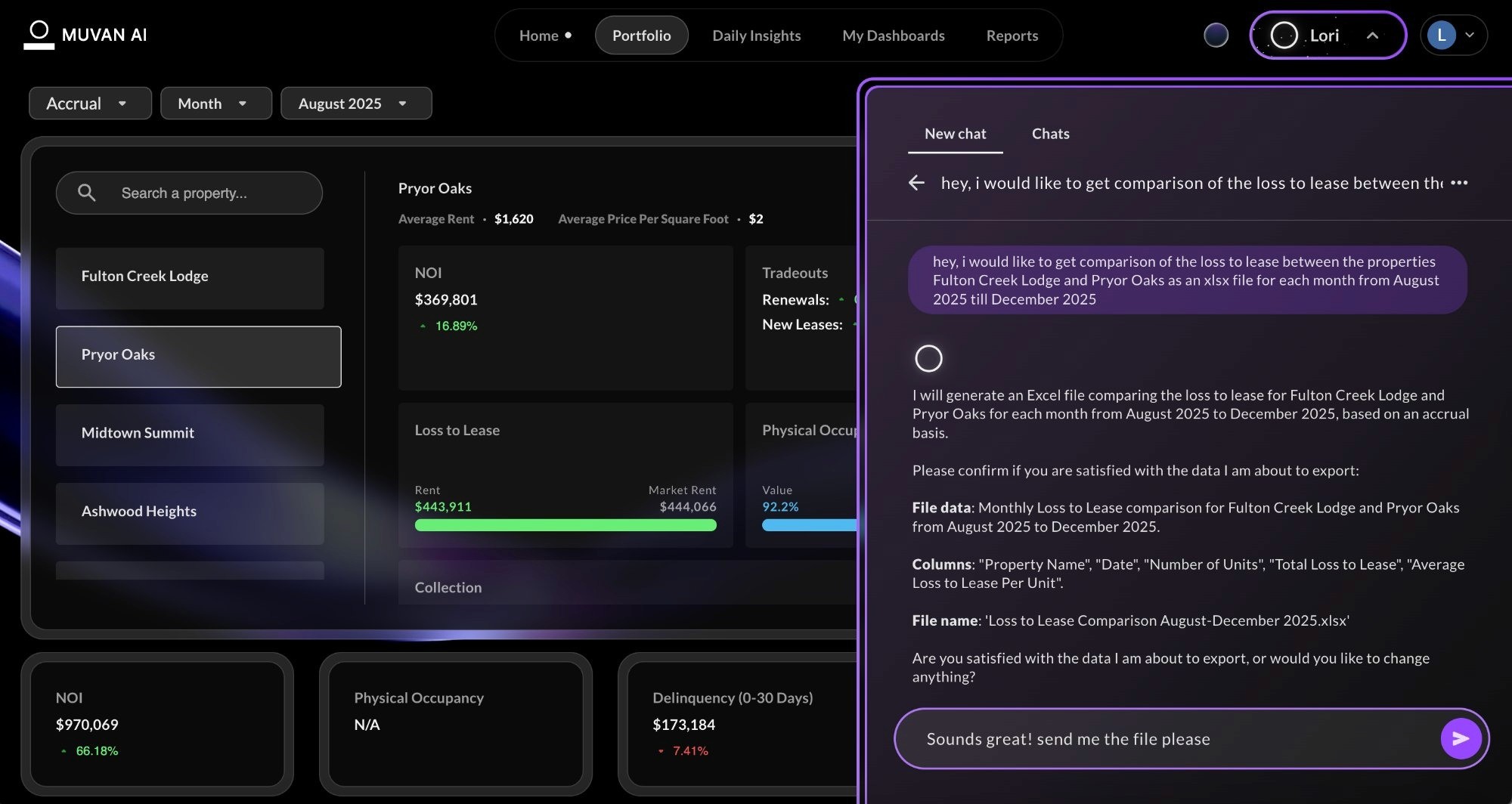
Lori analyzing loss-to-lease data across properties — comparing Fulton Creek Lodge and Pryor Oaks with real-time portfolio metrics
2. How Do AI Tools Turn Your Multifamily Leasing Pipeline Into a Managed Sales Funnel?
AI tools transform multifamily leasing pipelines by connecting AI lead generation sources to a full conversion funnel — lead to tour to application to signed lease — so operators can see not just lead volume but cost-per-lease by channel and conversion rates at every stage.
Every multifamily operator spends money on lead generation — ILS listings on Apartments.com, Zillow, RentCafe; Google Ads; social media campaigns; referral programs; signage. But ask most asset managers a straightforward question — “Which leasing source delivers the highest tour-to-lease conversion rate across your portfolio?” — and you will get silence, a guess, or a request to “pull that data from the PMS.”
This is not a failure of effort. It is a failure of tooling. Legacy property management systems track lead volume by source, but they rarely connect leads to tours, tours to applications, and applications to signed leases in a clean, analyzable funnel. The data exists across disconnected systems, and stitching it together manually is a project, not a process.
From Lead Volume to Conversion Intelligence
AI-powered leasing analytics treat your marketing spend the same way a SaaS company treats its sales pipeline: as a measurable funnel with defined stages and conversion rates at each step. The goal is not more data — it is better decisions about where to allocate your leasing dollars.
Muvan’s Lori analyzes leasing sources as a true sales funnel, connecting the dots across every stage of the prospect journey:
Source-Level Funnel Tracking: Lori maps each leasing source — from ILSs to walk-ins to broker referrals — through the full funnel: lead → tour → application → signed lease. You do not just see that Apartments.com generated 300 leads last month. You see that those 300 leads converted to 45 tours, 18 applications, and 12 leases — a 4% lead-to-lease rate. Meanwhile, Google Ads generated 80 leads but converted at 11%. That changes your budget allocation immediately.
Cost-Per-Lease by Source: By integrating your marketing spend data, Lori calculates the true cost-per-lease for every channel. If you are spending $15,000 per month on an ILS that delivers a $1,250 cost-per-lease, and your Google campaign delivers leases at $400 each, the reallocation decision becomes obvious — and quantifiable.
Drop-Off Analysis: Where are prospects falling out of the funnel? If a property has a strong tour rate but a weak application rate, the problem is likely on-site execution or pricing — not marketing. Lori surfaces these drop-off points at the property level so regional managers can diagnose issues without running a manual audit.
Portfolio-Level Benchmarking: Instead of evaluating each property’s leasing performance in isolation, Lori benchmarks conversion rates across your portfolio. If 7 of your 10 Southeast properties convert tours at 40% but one property converts at 18%, that outlier is immediately visible — and actionable.
[CALLOUT: The average multifamily operator cannot answer the question “What is my cost-per-lease by source?” without a manual data project. AI eliminates the project and delivers the answer in seconds.]
The 2025 State of AI in Multifamily report found that 85% of operators using AI reported measurable improvements in lead-to-lease conversion rates. The operators driving those improvements are not simply adding AI chatbots to their apartment websites — they are using AI to understand which channels deliver qualified prospects and which ones burn marketing dollars on volume that never converts.
For VPs of Marketing and regional managers, this kind of leasing intelligence is transformative. It moves the conversation from “how many leads did we get?” to “how efficiently did those leads become revenue?” — and it does so in real time, not in a quarterly report that arrives three weeks after the decisions needed to be made.
Resource: See how Muvan connects leasing intelligence to portfolio performance
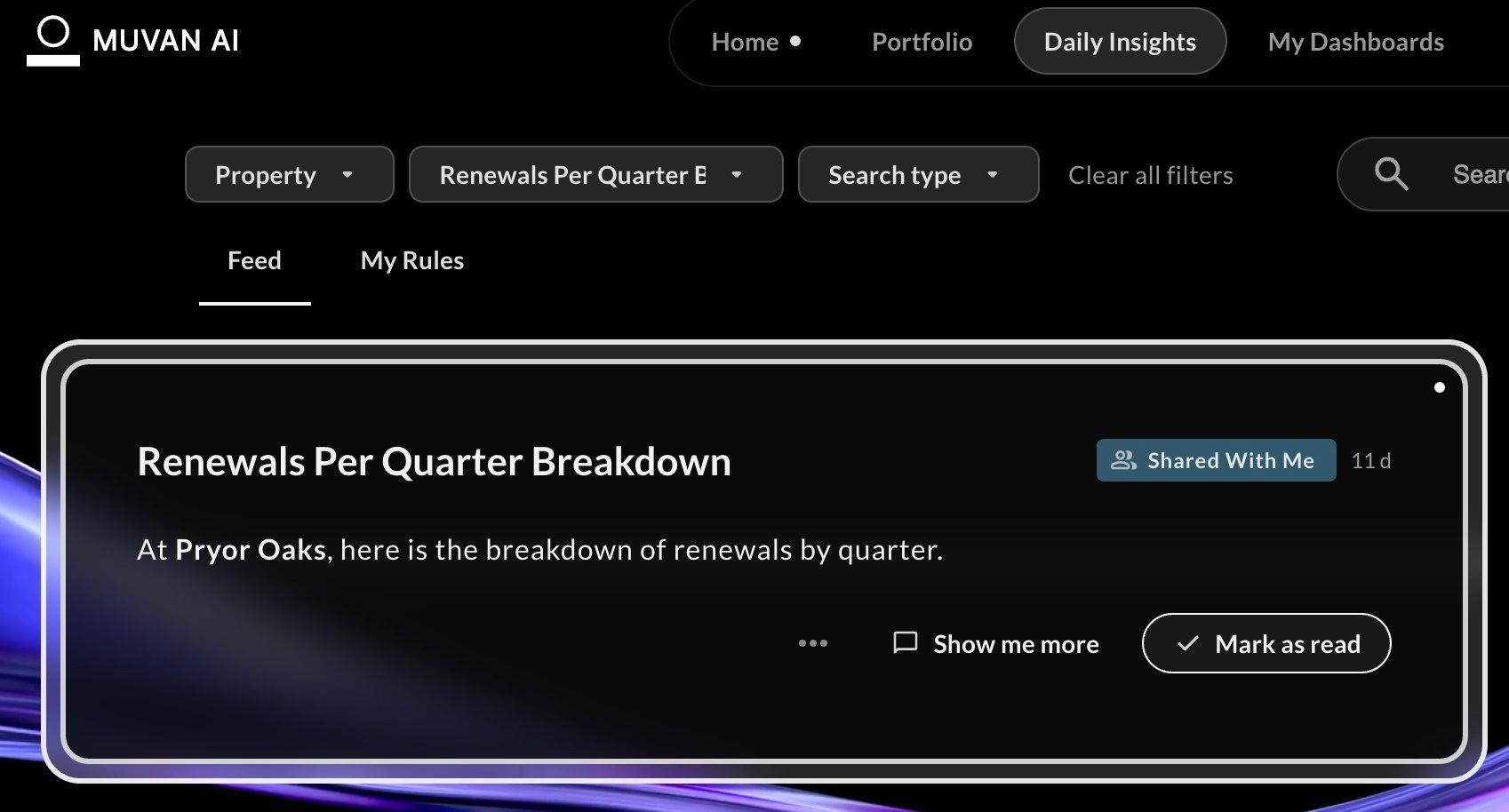
Muvan’s Daily Insights proactively surfacing renewal patterns — giving asset managers leasing intelligence without running a single report
3. Boosting Ancillary Income: The AI Use Case Nobody Talks About
AI boosts multifamily ancillary income by benchmarking every fee category across your portfolio, flagging underpriced services, identifying low-utilization amenities, and surfacing new fee opportunities that similar properties already monetize — turning a category most operators manage on autopilot into a data-driven NOI lever.
Ancillary income — the revenue generated beyond base rent from fees and services like parking, pet rent, storage, utility reimbursements, and amenity packages — has become one of the most important levers in multifamily finance. With rent growth remaining flat or even negative in several major markets through late 2025 and into 2026, operators are under pressure to find revenue streams that drop directly to the bottom line without raising headline rents.
The math is compelling. Analysis of over 1.3 million multifamily units (Amenify, 2024) shows that approximately two-thirds of operators already charge for ancillary services beyond base rent. Yet ancillary income as a share of total scheduled charges averages only around 4–5% for many portfolios — a figure that most asset managers and investors agree should be significantly higher. At a 5% cap rate, every additional $100 per unit per year in ancillary income translates to $2,000 in added asset value per unit. For a 3,000-unit portfolio, that is $6 million in value creation from a category most operators manage on autopilot.
The Problem: Ancillary Income Is Managed Manually and Inconsistently
Here is what typically happens with ancillary revenue at a multi-property portfolio: each property manager sets their own fees based on local norms, gut feeling, and whatever the last manager charged before them. Property A charges $50 per month for covered parking; Property B — in the same submarket, same asset class — charges $25. Property C does not charge for storage units at all because “we’ve never charged for those.” Nobody at the corporate level has a clean view of what each property charges versus what it could charge.
How AI Transforms Ancillary Revenue Strategy
Muvan’s Lori analyzes ancillary income at the in-property level, comparing what each property charges across every fee category against its own historical data, against other properties in your portfolio, and against submarket norms. The result is a property-by-property map of ancillary revenue opportunities that would take a human analyst weeks to compile.
Fee Benchmarking Across the Portfolio: Lori identifies variance in ancillary charges across your properties and flags underpriced categories. If your Austin properties charge $35 per month for pet rent but your Dallas properties in a comparable asset class charge $50, Lori surfaces that gap with the estimated annual revenue impact of closing it.
Utilization Analysis: It is not just about pricing — it is about adoption. If a property has 40 storage units but only 12 are leased, Lori flags the low utilization rate and estimates the revenue impact of marketing those units more effectively. The same applies to parking spots, EV charging stations, and premium amenity packages.
New Fee Opportunity Identification: Lori analyzes your property’s characteristics — unit mix, amenity set, submarket demographics — and identifies ancillary revenue categories that similar properties monetize but yours does not. If peer properties in your submarket charge a technology package fee and your property offers the same amenities without charging, that is a quantified opportunity.
[SHAREABLE] Ancillary income is the most underleveraged NOI driver in multifamily. Two-thirds of operators charge for services beyond rent, but most manage those fees on autopilot. AI finds the gap between what you charge and what you should charge.
For asset managers and CFOs, this is not about nickel-and-diming residents. It is about pricing your services at market rate and ensuring consistency across your portfolio. When ancillary fees are priced accurately and transparently, residents receive clear value for what they pay, and the portfolio captures revenue that would otherwise go unrealized.
Resource: Read about expense ratio optimization via predictive maintenance and IoT analytics
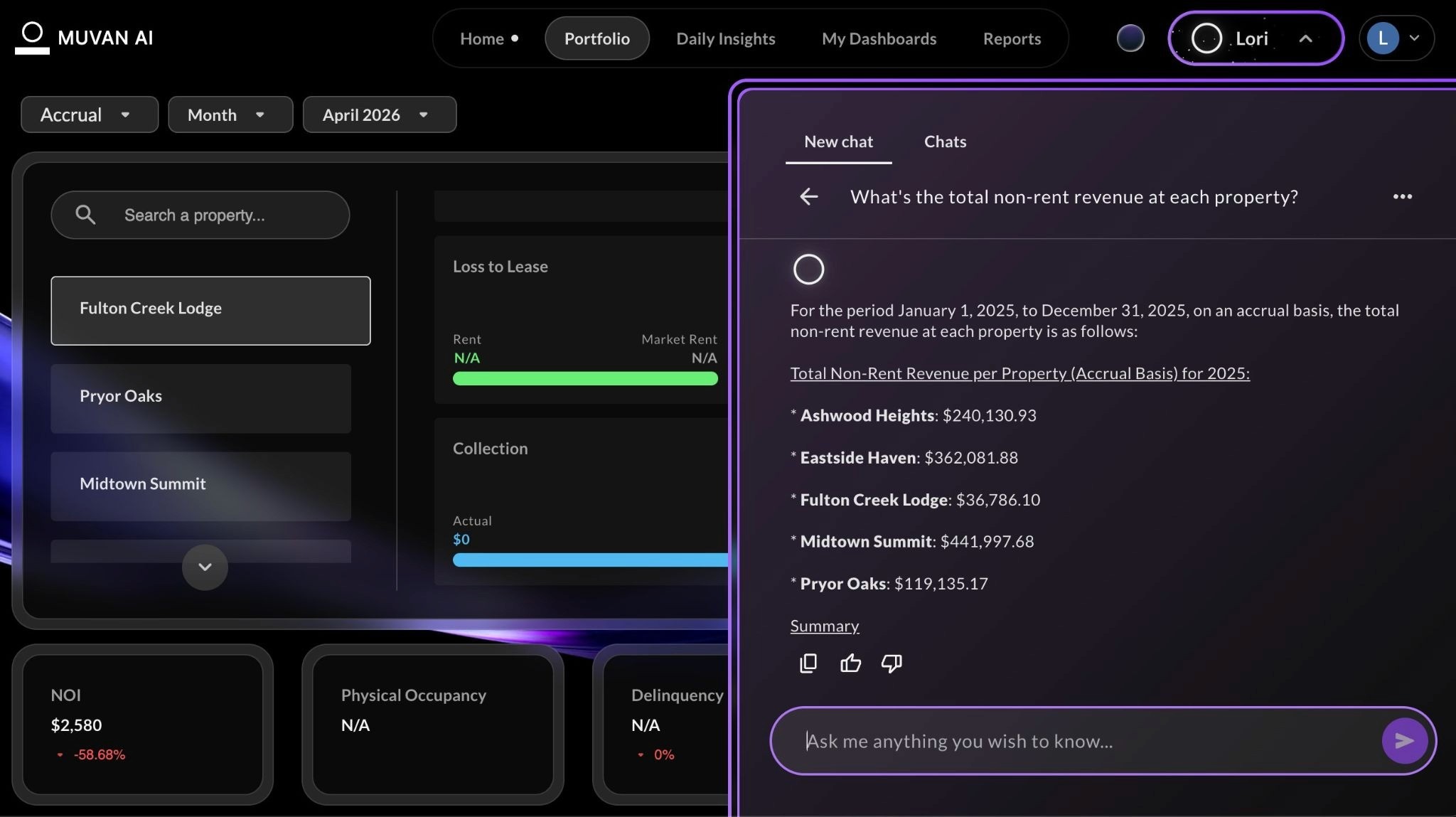
Lori answering “What’s the total non-rent revenue at each property?” — surfacing ancillary income across the portfolio in seconds
4. How Does AI Tell You Which Units to Renovate First? CapEx vs. ROI in Multifamily
AI determines which multifamily units to renovate first by evaluating multiple variables simultaneously — rent gap to post-renovation market ceiling, lease expiration timing, estimated renovation cost, and historical performance benchmarks — producing a prioritized pipeline that maximizes AI ROI for property management CapEx decisions.
Every owner-operator with a value-add strategy faces the same question: which units should get the renovation dollars? A 3,000-unit portfolio might have 800 units eligible for interior upgrades. Budget constraints mean you can renovate 200 this year. Which 200?
Traditionally, this decision is made with a blend of spreadsheet analysis and institutional intuition. The asset manager looks at the rent roll, estimates a post-renovation rent premium, subtracts the renovation cost, and ranks units by projected return. The problem is that this analysis rarely accounts for the full picture: lease expiration timing, submarket rent trajectory, unit condition variance, historical renovation performance at similar properties, and the opportunity cost of renovating one unit versus another. While Chapter 1 covered how Lori identifies loss-to-lease at current rents, the CapEx analysis takes this further by projecting what the rent gap would be after renovation — factoring in costs, timing, and historical outcomes to determine where your dollars will work hardest.
AI-Driven CapEx Prioritization: Data Over Gut Feeling
Muvan’s Lori approaches unit renovation prioritization as a multi-variable optimization problem, not a single-column spreadsheet sort. It evaluates every eligible unit across the factors that actually determine renovation ROI:
Rent Gap to Market Ceiling: Lori calculates the gap between each unit’s current in-place rent and the post-renovation rent ceiling in its submarket. A unit paying $1,200 with a post-renovation ceiling of $1,550 has a $350 monthly upside — $4,200 annually. But a unit paying $1,400 with a ceiling of $1,600 has only $200 monthly upside — $2,400 annually. Same renovation cost, dramatically different returns.
Lease Expiration Timing: A unit with a lease expiring in 60 days is a near-term renovation candidate. A unit with 10 months remaining on its lease is not — unless the resident is flagged as a move-out risk. Lori integrates lease timing into the prioritization so your renovation pipeline aligns with actual unit availability, reducing costly vacancy gaps between move-out and renovation completion.
Renovation Cost Variance: Not all units require the same scope. A unit that needs only countertops and fixtures might cost $5,000 to renovate, while a unit requiring a full kitchen and bathroom overhaul costs $18,000. Lori factors in estimated renovation scope to calculate the true ROI per dollar spent, not just the absolute rent premium.
Historical Performance Benchmarking: What rent premiums have similar renovations actually achieved at this property and at comparable properties in the portfolio? Lori uses historical renovation performance data to ground its projections in reality, not in pro forma assumptions that never materialized. This same analytical approach — using historical patterns to predict future outcomes — also extends to predictive maintenance, where AI flags units with escalating repair costs that may warrant full renovation over continued patchwork.
[CALLOUT: The difference between a good renovation program and a great one is not the scope of work — it is the sequence. AI ensures every dollar goes to the unit with the highest return first.]
For PE-backed owner-operators and third-party management firms executing value-add business plans, this capability directly impacts investor returns. A portfolio that renovates in the right sequence — highest-ROI units first, timed to lease expirations, calibrated to submarket conditions — will outperform an identical portfolio renovating in a default order. Over a 5-year hold period, the compounding effect of optimized CapEx sequencing can represent millions of dollars in additional value creation.
This is where AI moves from operational convenience to genuine competitive advantage. The data to make these decisions has always existed — scattered across rent rolls, capital budgets, market studies, and renovation trackers. What has not existed, until now, is a tool that synthesizes all of it into a single, continuously updated prioritization model.
Resource: Read about capital expenditure scheduling and lifecycle cost modeling
Resource: See how Muvan ranks renovation opportunities across your portfolio
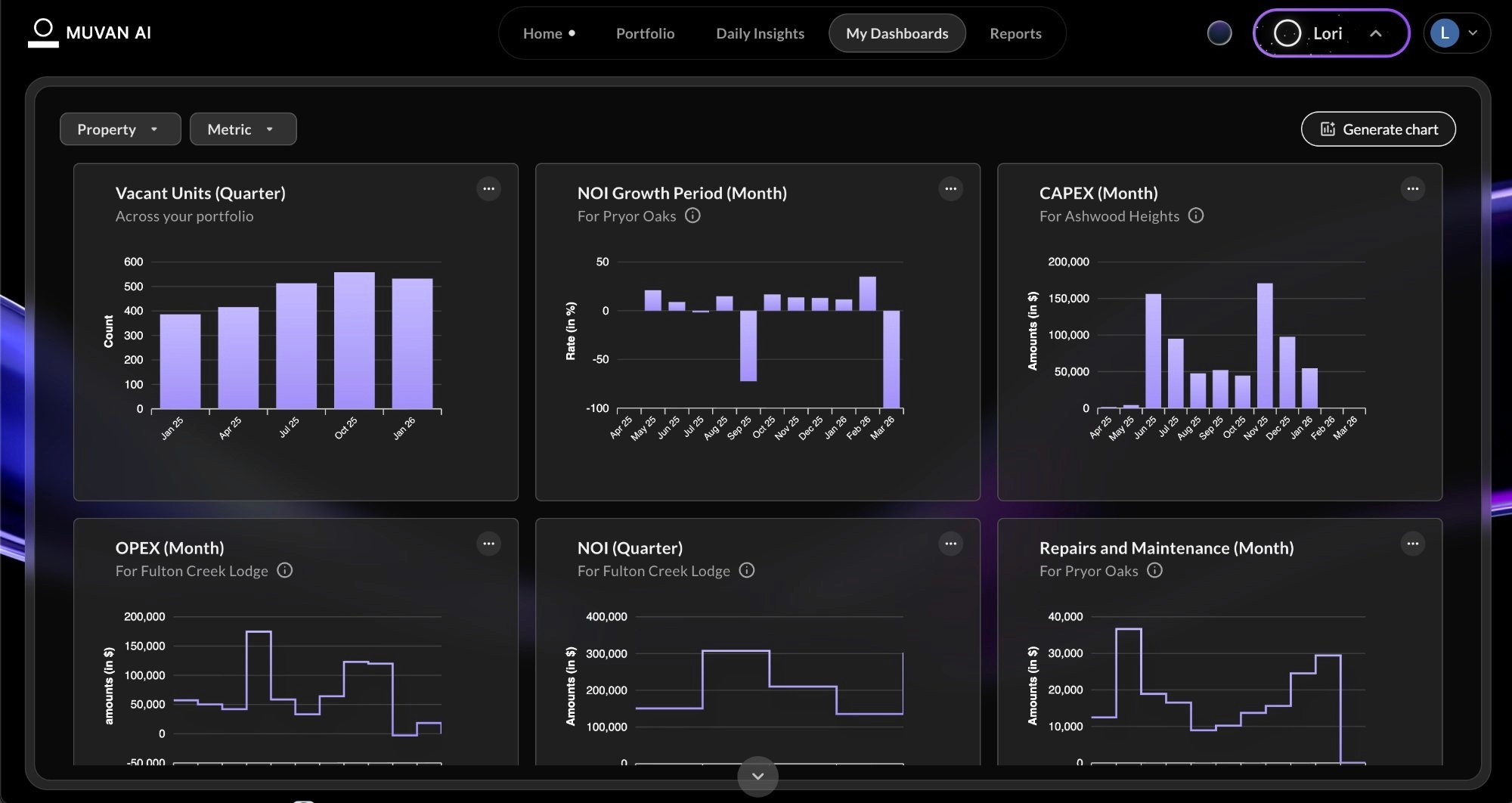
Muvan dashboards showing CapEx spending, NOI trends, vacancy data, and repairs & maintenance across portfolio properties
AI Tools for Multifamily: What They Actually Do
Not all AI tools are created equal. Here is how each capability compares across three approaches: the legacy manual process, a generic AI add-on layered on top of existing software, and an AI-native platform purpose-built for multifamily asset intelligence.
Capability | Legacy / Manual | Generic AI Add-On | Muvan (AI-Native) |
Revenue Optimization | Quarterly rent comp spreadsheet; manual loss-to-lease analysis | Basic rent recommendations; limited to single-property view | Continuous portfolio-wide revenue intelligence; unit-level loss-to-lease, concession burn, and renewal pricing via Lori |
Leasing Funnel Analytics | Lead count by source from PMS; no funnel visibility | Chatbot engagement metrics; lead scoring | Full-funnel source tracking (lead → tour → app → lease); cost-per-lease by channel; portfolio benchmarking |
Ancillary Income | Property-by-property fee schedules in Excel; no cross-portfolio view | Not typically covered by AI add-ons | In-property fee analysis; cross-portfolio benchmarking; utilization tracking; new fee opportunity identification |
CapEx Prioritization | Flat spreadsheet ranking by estimated rent premium minus renovation cost | Basic renovation ROI calculator; single-variable | Multi-variable unit ranking: rent gap, lease timing, renovation cost, historical benchmarks, submarket trajectory |
Data Interface | Static dashboards; CSV exports | Pre-built reports; filtered dashboards | Conversational AI (NLP) — ask Lori in plain English and get instant, contextual answers |
Time to Insight | Days to weeks | Hours to days | Seconds |
The Operators Winning in 2026 Are Not Using More AI — They Are Using Smarter AI
AI in multifamily is not one tool. It is an intelligence layer that runs across revenue management, leasing operations, ancillary strategy, and capital planning. The operators winning in 2026 are not the ones with the most AI features on a product page — they are the ones whose AI actually connects these four layers into a single, queryable view of portfolio performance.
And these four capabilities do not operate in isolation — they compound. Revenue optimization data feeds directly into CapEx decisions: if Lori identifies a cluster of units with persistent loss-to-lease gaps, the CapEx model can evaluate whether those gaps are best closed through market-rate renewal pricing or through renovation that unlocks a higher rent ceiling. Leasing funnel analytics inform ancillary income strategy: if a property’s strongest lead source delivers residents with a higher propensity for premium amenity packages, that insight shapes both marketing spend and fee structure. The compounding effect of these connections is what separates a collection of point solutions from an integrated AI platform.
This is the promise of agentic AI in real estate — AI that does not just answer questions or generate reports, but actively identifies opportunities, connects data across systems, and recommends specific actions based on portfolio-wide intelligence. The industry is moving beyond generative AI that drafts emails and chatbot scripts toward agentic systems that execute analysis autonomously and surface insights human analysts would take weeks to find.
That is the difference between an AI label and an AI platform. A chatbot answers prospect questions. An AI copilot like Muvan’s Lori tells an asset manager that their Phoenix portfolio has unrealized annual revenue across loss-to-lease gaps, underpriced parking fees, and three buildings where Google Ads are outperforming an expensive ILS contract by a factor of three — all in a single conversational query.
One is a feature. The other is a competitive advantage. The PwC and Urban Land Institute’s Emerging Trends in Real Estate 2026 report confirms that AI is moving from experimentation to operational reality across real estate — and that early adopters concentrated among residential operators are already finding success using AI tools to streamline services and create efficiencies. The gap between operators leveraging AI for portfolio intelligence and those relying on manual processes is widening every quarter. The question is no longer whether to adopt AI. It is whether the AI you adopt will deliver intelligence at the portfolio level, or just automation at the property level.
[SHAREABLE] AI in multifamily is not one tool. It is an intelligence layer across revenue, leasing, ancillary income, and capital planning. The operators winning in 2026 are not using more AI — they are using smarter AI.
See how leading multifamily operators are connecting all four layers with Muvan.
Resource: Explore the best multifamily AI software in 2026
Frequently Asked Questions
What are the best AI tools for multifamily property management in 2026?
The best AI tools for multifamily in 2026 are purpose-built platforms that go beyond chatbots and automated emails to deliver portfolio-level financial intelligence. The key differentiator is whether the AI tool provides actionable insights at the asset and portfolio level — not just at the property level. Look for platforms that offer conversational AI interfaces, automated reporting, proactive risk alerts, and integration with your existing PMS and data sources. Muvan’s AI copilot, Lori, is designed to deliver this kind of intelligence across revenue optimization, leasing analytics, ancillary income, and CapEx prioritization. For a detailed look at what separates AI-native platforms from legacy add-ons, see our multifamily AI software guide.
How does AI improve NOI in multifamily real estate?
AI improves multifamily NOI through four primary channels: revenue optimization (identifying loss-to-lease gaps and pricing opportunities), leasing efficiency (reducing marketing waste through funnel analytics), ancillary income growth (surfacing underpriced fees and underutilized amenities), and CapEx optimization (prioritizing renovations by ROI potential). Measuring AI ROI in property management requires looking at the cumulative impact across these channels, not at any single feature in isolation. According to a 2025 survey of 280 multifamily executives, 77% of operators using AI report moderate to significant reductions in operating expenses. The compounding effect of these improvements across a multi-property portfolio can represent millions in additional NOI annually.
What is an AI copilot for property management?
An AI copilot is a conversational AI interface — powered by natural language processing (NLP) — that allows asset managers and operators to interact with their data using plain language instead of navigating dashboards and running manual reports. Muvan’s AI copilot, Lori, is an NLP model trained specifically on multifamily and financial datasets. Instead of clicking through tabs to find your occupancy trend or exporting a rent roll to Excel, you ask Lori a question in plain English — for example, “Which properties in my Southeast portfolio have the highest loss-to-lease?” — and receive an instant, data-backed answer.
How does AI analyze leasing sources in multifamily?
AI-powered leasing analytics connect your lead sources (ILSs, Google Ads, walk-ins, referrals) to a full conversion funnel: lead → tour → application → signed lease. This allows operators to see not just how many leads each source generates, but how many of those leads convert to revenue. By calculating cost-per-lease by source and benchmarking conversion rates across properties, AI leasing tools help regional managers and VPs of Marketing allocate budgets to the channels that deliver actual leases — not just lead volume.
Can AI help identify CapEx renovation opportunities in multifamily?
Yes. AI-native platforms like Muvan analyze multiple variables simultaneously to rank units by renovation ROI potential: the gap between in-place rent and post-renovation market ceiling, estimated renovation cost, lease expiration timing, and historical renovation performance at comparable properties. This multi-variable approach produces a prioritized renovation pipeline that maximizes return per dollar spent, rather than relying on a simple rent-premium-minus-cost calculation.
What is the difference between AI-native and legacy multifamily software?
Legacy multifamily software was built as a system of record — designed to store and organize property data, process transactions, and generate static reports. When these platforms add AI, it is typically layered on top of an architecture that was not designed for intelligence. AI-native platforms like Muvan are built from the ground up around machine learning, natural language processing (NLP), and real-time predictive analytics. The result is proactive intelligence (the system tells you what to do) versus reactive reporting (the system tells you what happened). For a deeper exploration of this distinction, see our article on the best multifamily AI software in 2026.
Related Articles
• The Multifamily Software With the Best AI Features in 2026
• Revenue Management Algorithms for Multifamily and Hospitality Assets
• Capital Expenditure Scheduling and Lifecycle Cost Modeling
• Expense Ratio Optimization via Predictive Maintenance and IoT Analytics
Ready to see Lori in action? Request a Demo and experience your data in natural language.