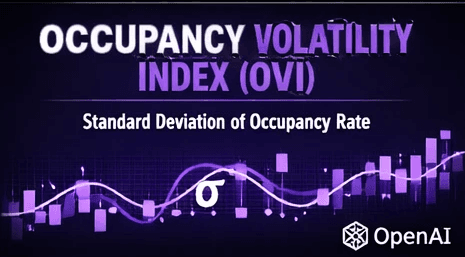
Stochastic Occupancy Modeling and Volatility Forecasting
Main KPI: Occupancy Volatility Index (OVI)
Primary topics: occupancy volatility, stochastic modeling, tenant churn, vacancy forecasting, absorption rate variance, Monte Carlo simulation, Markov chains, time-series econometrics
1. Introduction: Why Occupancy Volatility Matters in Asset Performance
Occupancy is the single most immediate operational driver of real estate cash flow stability. While average occupancy levels are commonly reported as a headline metric, the deeper and more technically relevant dimension is occupancy volatility, which captures the magnitude and frequency of occupancy fluctuations over time.
For institutional-grade real estate portfolios, volatility in occupancy is not merely a leasing concern. It is a structural risk factor that propagates into:
NOI instability
Cash flow unpredictability
Debt covenant breach probability
Valuation dispersion
Asset optimization inefficiency
This is why modern asset management increasingly treats occupancy as a stochastic process rather than a deterministic KPI.
In this deep dive, we develop a rigorous quantitative framework for modeling occupancy volatility using probabilistic methods, including:
Markov chain transition systems
Monte Carlo occupancy path simulation
Time-series volatility forecasting models (ARIMA, GARCH)
Tenant churn hazard modeling
Absorption rate stochasticity
2. Defining Occupancy as a Stochastic State Variable
Occupancy is traditionally expressed as:
Occt=Leased AreatTotal Rentable AreaOcc_t = \frac{\text{Leased Area}_t}{\text{Total Rentable Area}}Occt=Total Rentable AreaLeased Areat
However, this static ratio fails to capture the dynamic uncertainty inherent in leasing markets.
Instead, occupancy should be represented as a stochastic process:
Occt=f(Occt−1,ϵt)Occ_t = f(Occ_{t-1}, \epsilon_t)Occt=f(Occt−1,ϵt)
Where:
OcctOcc_tOcct = occupancy at time ttt
fff = structural transition function
ϵt\epsilon_tϵt = random shock component
This formulation enables modeling occupancy trajectories under uncertainty, rather than relying on point forecasts.
Key stochastic drivers of occupancy
Occupancy dynamics are influenced by:
Tenant churn probability
Renewal likelihood
Market absorption volatility
Lease-up speed variance
Macro demand shocks
Competitive supply shocks
3. Core KPI: Occupancy Volatility Index (OVI)
3.1 KPI Definition
The Occupancy Volatility Index (OVI) measures the standard deviation of occupancy over a rolling window:
OVI=σ(Occt−n,...,Occt)OVI = \sigma(Occ_{t-n},...,Occ_t)OVI=σ(Occt−n,...,Occt)
Where:
nnn = rolling period length (e.g., 12 months)
σ\sigmaσ = standard deviation
3.2 Interpretation
OVI Level | Meaning |
|---|---|
Low (<2%) | Stable tenant base, predictable NOI |
Moderate (2–5%) | Manageable leasing fluctuations |
High (>5%) | Structural churn risk, unstable cash flow |
3.3 Why OVI Matters More Than Average Occupancy
Two assets may both report 94% occupancy, but:
Asset A: stable 94–95%
Asset B: oscillates 85–100%
Asset B has higher NOI risk despite identical averages.
(See Section 7 for NOI propagation modeling.)
4. Tenant Churn as a Probabilistic Hazard Process
Occupancy volatility begins at the tenant level.
4.1 Tenant Exit Probability
Each tenant iii has a churn probability:
Pi(exit)=1−Pi(renew)P_i(\text{exit}) = 1 - P_i(\text{renew})Pi(exit)=1−Pi(renew)
Renewal probability depends on:
Rent delta vs market
Tenant business health
Lease term remaining
Space efficiency
Asset quality
4.2 Hazard Rate Modeling
A technical approach uses survival analysis:
h(t)=limΔt→0P(t≤T<t+Δt)Δth(t) = \lim_{\Delta t \to 0} \frac{P(t \leq T < t+\Delta t)}{\Delta t}h(t)=Δt→0limΔtP(t≤T<t+Δt)
Where:
h(t)h(t)h(t) = hazard rate
TTT = tenant lease termination time
Hazard models allow churn forecasting beyond binary renewal assumptions.
Example: Cox Proportional Hazard Model
hi(t)=h0(t)exp(βXi)h_i(t) = h_0(t)\exp(\beta X_i)hi(t)=h0(t)exp(βXi)
Where XiX_iXi includes:
Rent premium
Tenant size
Industry risk
Market vacancy
5. Markov Chain Occupancy Transition Modeling
5.1 Occupancy States
Occupancy can be discretized into state bins:
State | Occupancy Range |
|---|---|
S1 | 0–70% |
S2 | 70–85% |
S3 | 85–95% |
S4 | 95–100% |
Occupancy becomes a Markov process:
P(Occt+1∣Occt)P(Occ_{t+1} | Occ_t)P(Occt+1∣Occt)
5.2 Transition Matrix
T=[0.600.300.100.000.150.500.300.050.050.200.600.150.000.050.250.70]T = \begin{bmatrix} 0.60 & 0.30 & 0.10 & 0.00 \\ 0.15 & 0.50 & 0.30 & 0.05 \\ 0.05 & 0.20 & 0.60 & 0.15 \\ 0.00 & 0.05 & 0.25 & 0.70 \end{bmatrix}T=0.600.150.050.000.300.500.200.050.100.300.600.250.000.050.150.70
Each element TijT_{ij}Tij represents:
P(St+1=j∣St=i)P(S_{t+1}=j | S_t=i)P(St+1=j∣St=i)
5.3 Forecasting Occupancy Distribution
Starting state vector:
π0=[0,0,1,0]\pi_0 = [0,0,1,0]π0=[0,0,1,0]
After kkk periods:
πk=π0Tk\pi_k = \pi_0 T^kπk=π0Tk
This produces a probabilistic occupancy forecast rather than a point estimate.
(See Section 8 for Monte Carlo integration.)
6. Absorption Rate Variance and Lease-Up Volatility
Absorption rate determines how quickly vacancy is filled.
6.1 Absorption as a Random Variable
Abst∼N(μ,σ2)Abs_t \sim \mathcal{N}(\mu,\sigma^2)Abst∼N(μ,σ2)
Where:
μ\muμ = expected lease-up rate
σ\sigmaσ = absorption volatility
6.2 Vacancy Duration Distribution
Expected vacancy duration:
E[D]=1AbstE[D] = \frac{1}{Abs_t}E[D]=Abst1
But stochastic absorption implies:
tail risk in lease-up
extended downtime scenarios
nonlinear NOI impact
Example
If absorption volatility increases from 5% to 15%, expected downtime variance triples, even if mean absorption remains constant.
7. Occupancy Volatility Propagation Into NOI
Occupancy volatility translates directly into NOI variance.
7.1 NOI Equation
NOIt=Rentt⋅Occt−OPEXtNOI_t = Rent_t \cdot Occ_t - OPEX_tNOIt=Rentt⋅Occt−OPEXt
Thus:
Var(NOIt)≈Rent2Var(Occt)Var(NOI_t) \approx Rent^2 Var(Occ_t)Var(NOIt)≈Rent2Var(Occt)
Meaning occupancy volatility is a first-order driver of NOI instability.
7.2 NOI-at-Risk (NOIaR)
Analogous to Value-at-Risk:
NOIaRα=NOImean−NOIαNOIaR_\alpha = NOI_{mean} - NOI_{\alpha}NOIaRα=NOImean−NOIα
Where NOIαNOI_{\alpha}NOIα is the α\alphaα-percentile worst-case NOI.
(See Section 9 for stress testing.)
8. Monte Carlo Simulation of Occupancy Paths
8.1 Why Monte Carlo
Occupancy evolves through multiple uncertain drivers:
churn
absorption
market shocks
renewal rates
Monte Carlo generates thousands of occupancy trajectories:
Occt(j)=f(Occt−1(j),ϵt(j))Occ_t^{(j)} = f(Occ_{t-1}^{(j)},\epsilon_t^{(j)})Occt(j)=f(Occt−1(j),ϵt(j))
8.2 Simulation Workflow
Initialize occupancy
Sample churn events
Sample absorption rate
Update occupancy
Repeat over horizon
Compute volatility distribution
Output Metrics
Expected occupancy
OVI distribution
Tail vacancy probability
NOI-at-risk
Example Result
Metric | Value |
|---|---|
Mean Occupancy | 93.2% |
OVI | 6.1% |
Probability <85% | 12% |
NOI Stress Loss | -18% |
9. Time-Series Econometric Forecasting (ARIMA + GARCH)
9.1 ARIMA Occupancy Forecast
Occt=c+ϕOcct−1+θϵt−1Occ_t = c + \phi Occ_{t-1} + \theta \epsilon_{t-1}Occt=c+ϕOcct−1+θϵt−1
Captures:
trend
seasonality
autocorrelation
9.2 GARCH Volatility Forecast
Occupancy volatility clusters over time:
σt2=α0+α1ϵt−12+β1σt−12\sigma_t^2 = \alpha_0 + \alpha_1\epsilon_{t-1}^2 + \beta_1\sigma_{t-1}^2σt2=α0+α1ϵt−12+β1σt−12
This allows forecasting not only occupancy but volatility itself.
Key Use Case
Predicting instability ahead of lease rollover events.
(See Section 10 for optimization applications.)
10. Asset Optimization Applications
Stochastic occupancy modeling is not academic. It enables real operational optimization:
10.1 Lease Structuring
Reduce volatility by:
staggering expiries
increasing weighted average lease term
embedding renewal incentives
10.2 Capital Deployment
Prioritize capex that improves retention probability:
ΔOVI→ΔNOIstability\Delta OVI \rightarrow \Delta NOI stabilityΔOVI→ΔNOIstability
10.3 Portfolio Risk Hedging
Diversify assets with uncorrelated occupancy shocks:
Corr(OccA,OccB)≈0Corr(Occ_A,Occ_B) \approx 0Corr(OccA,OccB)≈0
11. Summary of Key Technical Takeaways
Component | Model Type | Output |
|---|---|---|
Tenant churn | Hazard modeling | Renewal probability |
Occupancy transitions | Markov chain | State distribution |
Lease-up speed | Stochastic absorption | Vacancy duration |
Forecasting | ARIMA | Expected occupancy |
Volatility prediction | GARCH | OVI forward curve |
Tail risk | Monte Carlo | NOI-at-risk |