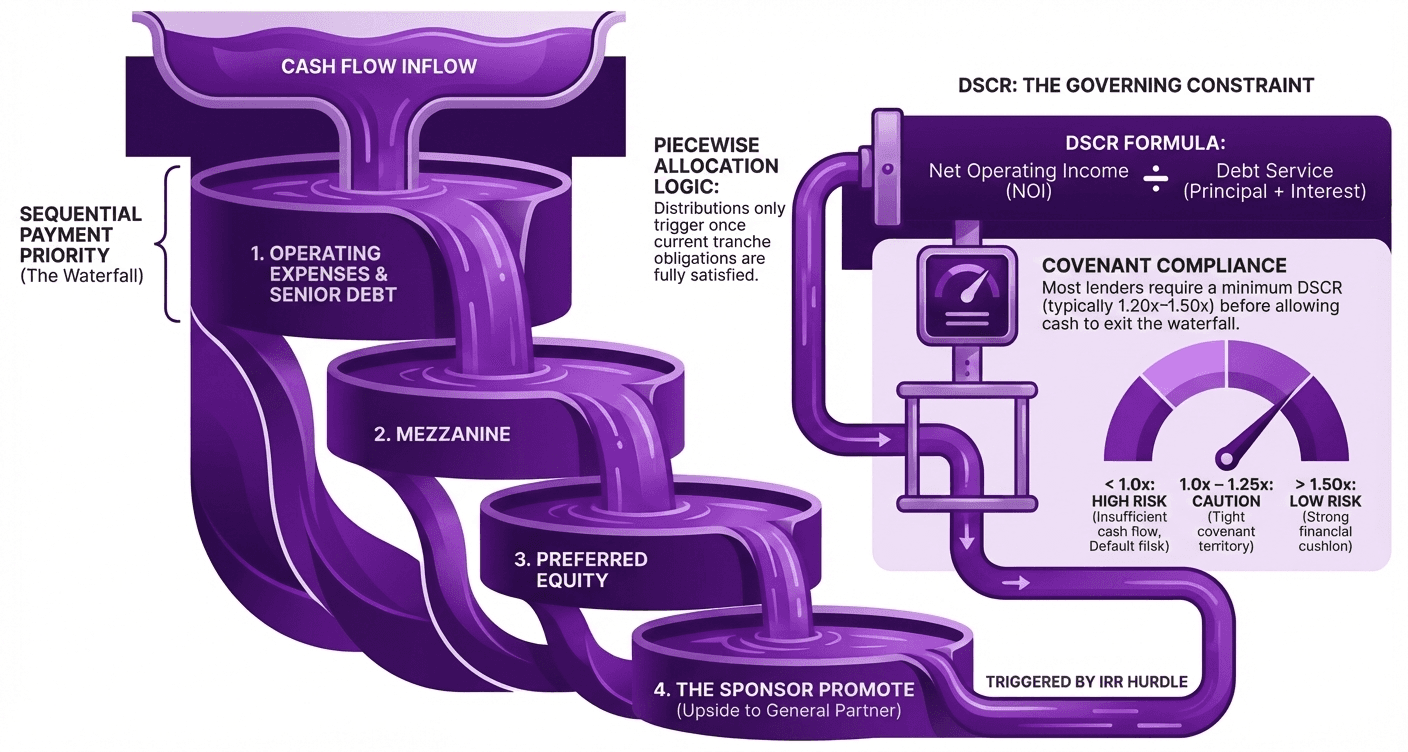
Dynamic Cash Flow Waterfall Optimization with Structured Finance Constraints
Main KPI: Debt Service Coverage Ratio (DSCR)
Primary Keywords: cash flow waterfall, structured finance, DSCR optimization, preferred equity, mezzanine debt, tranche modeling, covenant constraints, IRR maximization
1. Introduction: Why Cash Flow Waterfalls Are Structurally Complex
Real estate cash flow is not distributed linearly. Institutional assets are typically financed with layered capital structures that include:
Senior mortgage debt
Mezzanine financing
Preferred equity
Common equity
Promote structures
Each layer introduces priority rules that define how cash flows are allocated.
This allocation mechanism is known as the cash flow waterfall, and it is central to:
Equity return forecasting
Debt covenant compliance
Refinancing feasibility
Sponsor promote economics
Risk-adjusted asset optimization
Unlike simple discounted cash flow models, waterfall systems require:
Conditional payment logic
Multi-tranche priority sequencing
Dynamic constraint enforcement
Optimization under uncertainty
Thus, waterfall modeling is fundamentally a structured finance problem.
2. Cash Flow Waterfall Definition
2.1 Asset-Level Cash Flow
Unlevered net cash flow:
CFt=NOIt−CapextCF_t = NOI_t - Capex_tCFt=NOIt−Capext
Levered distributable cash flow:
DCFt=CFt−DebtServicetDCF_t = CF_t - DebtService_tDCFt=CFt−DebtServicet
This distributable amount is then allocated through the waterfall.
2.2 Waterfall Priority Structure
Typical hierarchy:
Operating expenses
Senior debt service
Reserve accounts
Preferred return to equity
Return of equity capital
Promote split (e.g., 70/30)
Excess cash sweep
This introduces nonlinearity into return outcomes.
3. Main KPI: Debt Service Coverage Ratio (DSCR)
3.1 KPI Definition
DSCRt=NOItDebtServicetDSCR_t = \frac{NOI_t}{DebtService_t}DSCRt=DebtServicetNOIt
Where:
NOItNOI_tNOIt = net operating income
DebtServicetDebtService_tDebtServicet = interest + principal due
3.2 Interpretation
DSCR | Meaning |
|---|---|
<1.0x | Insufficient cash flow (default risk) |
1.0–1.25x | Tight covenant territory |
1.25–1.50x | Healthy coverage |
>1.50x | Strong cushion |
DSCR is the dominant constraint in structured real estate finance.
3.3 DSCR as a Binding Optimization Constraint
Most debt agreements impose:
DSCRt≥DSCRminDSCR_t \geq DSCR_{min}DSCRt≥DSCRmin
Typically:
Multifamily: 1.20x
Office: 1.30–1.40x
Hospitality: 1.50x+
Waterfall optimization must ensure covenant compliance.
4. Structured Capital Stack Architecture
4.1 Senior Debt
Senior mortgage:
Lowest cost
First priority claim
Strong covenant constraints
Debt service:
DebtServicet=Interestt+AmortizationtDebtService_t = Interest_t + Amortization_tDebtServicet=Interestt+Amortizationt
4.2 Mezzanine Debt
Subordinate financing:
Higher interest
Often interest-only
Secured by equity pledge
Cash flow priority:
Senior→Mezz→EquitySenior \rightarrow Mezz \rightarrow EquitySenior→Mezz→Equity
4.3 Preferred Equity
Hybrid instrument:
Fixed preferred return
Paid before common equity
No foreclosure rights but control provisions
Preferred return:
PrefReturnt=rp⋅PrefCapitalPrefReturn_t = r_p \cdot PrefCapitalPrefReturnt=rp⋅PrefCapital
4.4 Common Equity + Promote
Sponsor equity earns upside through promote:
Example split:
LP receives 70%
GP receives 30% promote above hurdle IRR
Promote introduces convex payoff structures.
(See Section 7 for IRR nonlinearity.)
5. Waterfall Mechanics as Conditional Allocation Functions
5.1 Piecewise Distribution Rules
Cash flow allocation is piecewise:
Distt={PayDebt,CFt<DebtServicetPayPref,CFt>DebtServicetPayPromote,IRR>HurdleDist_t = \begin{cases} PayDebt, & CF_t < DebtService_t \\ PayPref, & CF_t > DebtService_t \\ PayPromote, & IRR > Hurdle \end{cases}Distt=⎩⎨⎧PayDebt,PayPref,PayPromote,CFt<DebtServicetCFt>DebtServicetIRR>Hurdle
This creates discontinuities in return profiles.
5.2 Example Waterfall Sequence
Assume:
NOI = $10M
Debt service = $6M
Remaining = $4M
Steps:
Pay preferred return: $2M
Return equity capital: $1M
Excess $1M split 70/30
GP promote = $0.3M
LP distribution = $0.7M
6. Waterfall Optimization Problem Formulation
6.1 Objective Function
Sponsor wants to maximize equity IRR:
maxIRRequity\max IRR_{equity}maxIRRequity
Subject to:
DSCR constraints
Preferred return obligations
Reserve requirements
Refinance limits
6.2 Optimization Constraints
Core constraint:
DSCRt≥1.25DSCR_t \geq 1.25DSCRt≥1.25
Liquidity constraint:
CashReservet≥ReserveminCashReserve_t \geq Reserve_{min}CashReservet≥Reservemin
Preferred equity constraint:
DCFt≥PrefReturntDCF_t \geq PrefReturn_tDCFt≥PrefReturnt
6.3 Decision Variables
Optimization levers:
Debt sizing
Interest-only vs amortizing
Refinance timing
Capex scheduling
Promote hurdle design
7. Nonlinear IRR Dynamics in Promote Structures
7.1 IRR Definition
Equity IRR solves:
0=∑t=0TCFt(1+IRR)t0 = \sum_{t=0}^{T} \frac{CF_t}{(1+IRR)^t}0=t=0∑T(1+IRR)tCFt
Promotes make cash flow asymmetric:
downside capped at loss
upside convex for GP
7.2 Promote Hurdle Example
If hurdle = 12% IRR:
Below 12%: LP gets 90%
Above 12%: GP promote increases to 30%
Thus:
DistGP={0.10CF,IRR<12%0.30CF,IRR>12%Dist_{GP} = \begin{cases} 0.10CF, & IRR < 12\% \\ 0.30CF, & IRR > 12\% \end{cases}DistGP={0.10CF,0.30CF,IRR<12%IRR>12%
This is equivalent to an embedded call option.
(See Topic 5 real options valuation.)
8. Dynamic DSCR Forecasting Under NOI Volatility
DSCR is stochastic because NOI is stochastic.
DSCRt=NOItDebtServicetDSCR_t = \frac{NOI_t}{DebtService_t}DSCRt=DebtServicetNOIt
NOI variance drives DSCR breach probability:
P(DSCRt<1.0)P(DSCR_t < 1.0)P(DSCRt<1.0)
Thus, optimization must incorporate NOI-at-risk.
(See Topic 2 Section 9 and Topic 9 deep dive.)
8.1 Monte Carlo DSCR Simulation
Simulate NOI paths:
NOIt(j)NOI_t^{(j)}NOIt(j)
Compute DSCR paths:
DSCRt(j)=NOIt(j)DebtServicetDSCR_t^{(j)} = \frac{NOI_t^{(j)}}{DebtService_t}DSCRt(j)=DebtServicetNOIt(j)
Then estimate:
Expected DSCR
Tail breach probability
Covenant stress scenarios
Example Output
Metric | Value |
|---|---|
Mean DSCR | 1.38x |
5th percentile DSCR | 1.05x |
Breach probability (<1.20x) | 18% |
9. Waterfall Stress Testing and Tranche Risk
9.1 Tranche Loss Allocation
In downturns, losses absorb bottom-up:
Common equity wiped
Preferred impaired
Mezz defaults
Senior threatened last
Expected loss per tranche:
ELi=PDi⋅LGDiEL_i = PD_i \cdot LGD_iELi=PDi⋅LGDi
Where:
PD = probability of default
LGD = loss given default
9.2 Cash Sweep Triggers
Many loans impose cash sweeps if DSCR falls:
DSCRt<1.15⇒Sweep=100%DSCR_t < 1.15 \Rightarrow Sweep = 100\%DSCRt<1.15⇒Sweep=100%
This removes equity distributions and accelerates deleveraging.
10. Asset Optimization Through Waterfall Engineering
Waterfall modeling enables optimization beyond financing.
10.1 Capex Timing
Capex reduces NOI temporarily but increases long-term rent.
Optimize:
maxIRR subject to DSCR stability\max IRR \text{ subject to DSCR stability}maxIRR subject to DSCR stability
10.2 Refinancing Strategy
Refi resets debt service:
DebtServicenew<DebtServiceoldDebtService_{new} < DebtService_{old}DebtServicenew<DebtServiceold
Improves DSCR and unlocks equity distributions.
10.3 Preferred Equity Restructuring
Refinance out expensive pref:
reduces fixed obligations
increases free cash flow
stabilizes waterfall
11. Portfolio-Level Structured Finance Optimization
At portfolio scale, managers optimize across assets:
max∑wiIRRi\max \sum w_i IRR_imax∑wiIRRi
Subject to:
portfolio DSCR minimum
liquidity coverage
correlated vacancy shocks
Diversification reduces tranche-level tail risk.
(See Topic 10 portfolio optimization.)
12. Summary of Key Technical Takeaways
Component | Model | Output |
|---|---|---|
Waterfall allocation | Priority sequencing | Distribution rules |
Key KPI | DSCR | Covenant compliance |
Promote convexity | Piecewise IRR | Sponsor upside |
Optimization | Constrained maximization | Capital efficiency |
Stress testing | Monte Carlo DSCR | Breach probability |
Tranche risk | Loss allocation | Structured downside |